
John Brown Connecticut Sites To See, Portrait By Augustus Washington
The meteor of the war! — Herman Melville
Born here.
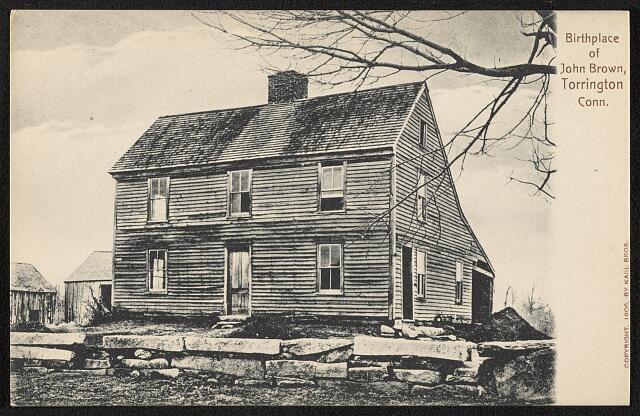
Title: Birthplace of John Brown, Torrington, Conn. (1906) Library of Congress Prints and Photographs Division, linked to source.
“While usually associated with Harpers Ferry, Virginia, John Brown has strong Connecticut connections.
“John Brown was born May 9, 1800 in West Torringford (now Torrington) to Owen and Ruth (Mills) Brown. He came from a long established family, with ties back to English Puritans. The house burned down in 1918, and in 1932 a monument was erected on the site. In 2000 the “Torrington Historical Society acquired the birthplace property in merger with the John Brown Association. Shortly after that, the Historical Society with support from the CT Humanities developed an interpretive plan for the birthplace.” In 2003 the site was placed on the State Register of Historic Places. A block in the Freedom Quilt represents John Brown’s contribution. Today you can visit the location of his birth place as part of The Connecticut Freedom Trail.
“The family moved to Ohio in 1805. At 16, John Brown returned to New England to attend preparatory school in Massachusetts, but soon transferred to the Morris Academy in Litchfield. The Morris Academy was a progressive school that was controversial back in 1790 for the open door policy of coeducation. Brown’s plan to become a Congregational minister was sidelined by financial and vision issues that forced him to quit school and return to Ohio.
“John Brown is most famous for his armed raid on the U.S. Armory and Arsenal at Harper’s Ferry, but that was just one part of his crusade to abolish slavery. In 1837 he publicly dedicated his life to the end of slavery. Already an abolitionist, his move to Springfield, MA marked an increase in his activism. He lived and worshiped with Black and White alike. At this time he began formulating ideas for the Subterranean Pass Way, a series of mountain bases for the Underground Railroad and from where armed parties could attack slave holders. He continued his work in North Elba, NY and around the country. Brown went to Hartford and sought out Augustus Washington, a famous African American photographer. It is now housed in the National Portrait Gallery, being the earliest known portrait of John Brown and possibly the earliest surviving image from Washington’s Hartford studio.
“In 1855, he went to Kansas in response to the Nebraska-Kansas Act and the pro-slavery people who were also moving to Kansas. In 1856 he was involved in a violent retaliation for the killing of free settlers in Kansas and that resulted in death of five pro-slavery men. On October 16, 1859, John Brown led his infamous attack at Harpers Ferry and was captured on October 18th. He was severely wounded, and was brought into the court house on a stretcher. Charged with conspiring with slaves to commit treason and murder, Brown was tried, convicted, and executed by the state of Virginia, even though the crime was under federal jurisdiction. John Brown was convicted November 2 and hung on December 2, 1859. In the intervening days, he wrote many letters to encourage the abolitionist movement and discussed his impending death as working for God’s will. For some, he was a martyr who died to free enslaved people; for others, he was a violent criminal.
“By 1862, ‘John Brown’s Body’ being sung and whistled all over the North. This is the song we now know as The Battle Hymn of the Republic, a song with lyrics that have changed over time. The Library of Congress has resources exploring this song, with links to song sheets and even a 1917 vocal performance.”
…………
Learned something amazing about the human who captured this portrait. Augustus Washington, Daguerreotypist. Wow.
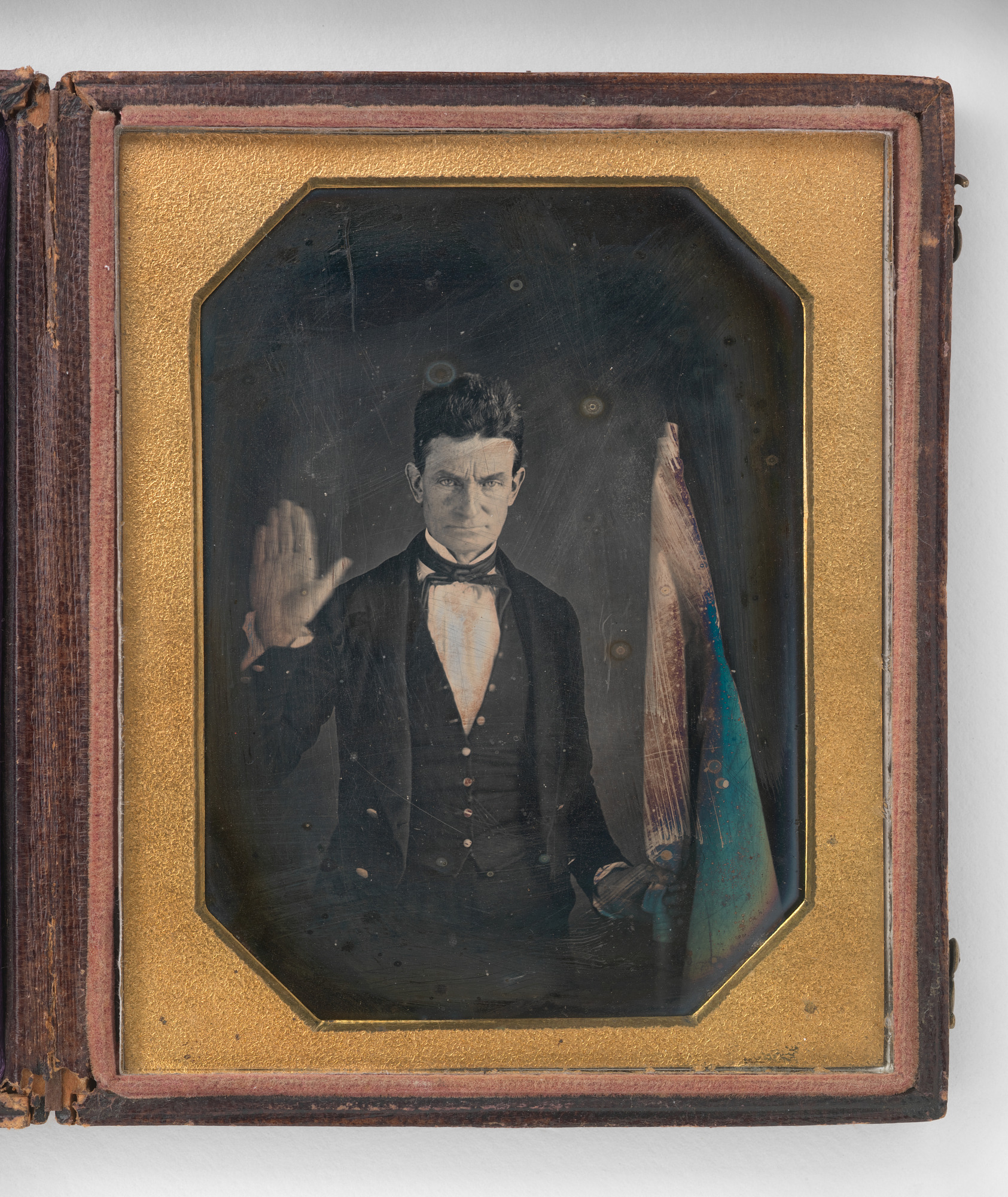
Created by Augustus Washington (1820/1 to 1875). Sitter: John Brown (9 May 1800 to 2 Dec 1859). Circa 1846-47 quarter-plate daguerreotype. Hartford, Connecticut. Credit: National Portrait Gallery, Smithsonian Institution; purchased with major acquisition funds and with funds donated by Betty Adler Schermer in honor of her great-grandfather, August M. Bondi. Image linked to source.
“Brown went to Hartford and sought out Augustus Washington, a famous African American photographer. It is now housed in the National Portrait Gallery, being the earliest known portrait of John Brown and possibly the earliest surviving image from Washington’s Hartford studio.”
More of his work, at the LOC.
——————
Have a yen to visit.
Torrington, Canton, CT; then Harpers Ferry.
torringtonhistoricalsociety.org/john-browns-… #history #JohnBrown
— Moo Dog Press (@moodogpress.com) June 18, 2026 at 11:27 AM
……………….
To walk in his footsteps, make plans soon.
……………………………
One of that ubiquitous class of persevering inquirers known as Reporters visited Harpers Ferry on the 18th and 19th of October, and was present at an interview between Senator Mason, Congressman Vallandigham, and the prisoner, Brown. The Reporter writes as follows:
Harper’s Ferry, Oct. 19, 1859.
“‘Old Brown,’ or ‘Ossawatomie Brown,’as he is often called, the hero of a dozen fights or so with the ‘border ruffians” of Missouri, in the days of “bleeding Kansas,’ is the head and front of this offending–the commander of the filibuster army. His wounds, which at first were supposed to be mortal, turn out to be mere flesh-wounds and scratches, not dangerous in their character. He has been removed, together with Stephens, the other wounded prisoner, from the engine-room to the office of the Armory, and they now lie on the floor, upon miserable shake-downs, covered with some old bedding.
“Brown is fifty-five years of age, rather small-sized, with keen and restless grey eyes, and a grizzly beard and hair. He is a wiry, active man, and, should the slightest chance for an escape be afforded, there is no doubt that he will yet give his captors much trouble. His hair is matted and tangled, and his face, hands, and clothes, all smouched and smeared with blood. Colonel Lee stated that he would exclude all visitors from the room if the wounded men were annoyed or pained by them, but Brown said he was by no means annoyed; on the contrary, he was glad to be able to make himself and his motives clearly understood. He converses freely, fluently and cheerfully, without the slightest manifestation of fear or uneasiness, evidently weighing well his words, and possessing a good command of language. His manner is courteous and affable, and he appears to make a favorable impression upon his auditory, which, during most of the day yesterday, averaged about ten or a dozen men.”
Yale Law School: The Avalon Project–Life, Trial and Execution of Captain John Brown; 1859
…………………………
The pikes. The following from https://cantonmuseum.org/reference/research/john-browns-canton-connections/
“Apparently this testimony satisfied the Congressional committee that Blair was innocent of any complicity in the Harper’s Ferry affair. The Collins Company’s name was never mentioned, although half of the pikes were forged there. As the Collins Company had large contracts for tools in the Southern states, it was important that the company not be implicated in any dealings with militant abolitionists.
“Subsequent history of the pikes reveals that none of them ever reached the hands of any freed slaves, although John Brown himself was armed with one of them when he was captured. About half of them were found on a cart at Harper’s Ferry and were quickly appropriated by souvenir collectors. The remainder, still at the farmhouse in Maryland where the conspirators had left them, were sent to the Federal Armory in Richmond, Virginia, where they were captured by the Confederacy at the onset of the Civil War. There is some evidence that they may have been used by the Confederate cavalry. A few were used by both North and South as propaganda tools. Wendell Philips regularly exhibited a John Brown pike at his anti-slavery lectures, and Edmund Ruffin, the fiery Southerner who fired the first shot at Fort Sumter, had a use for them, too. He acquired fifteen of the pikes and sent one to each Southern governor and some Congressmen with an explanation of its purpose. His label read, “Sample of the favors designed for us by our Northern brethren.”
…
“Two rough forgings of the “Brown pikes” were preserved in the safe of the Collins Company for over 100 years; one of these is now in the Canton Historical Museum and the other in the Connecticut Historical Society. At the Brown home and museum in North Elba, New York, there are two different styles of “Brown pikes”, presumably one kind forged in Collinsville and the other in Unionville. At least one of the twelve sample pikes has been discovered in the hands of a family in the Chambersburg, Pennsylvania area. It is likely that this was found among the others after the Harper’s Ferry raid and kept as a souvenir of that important inciting event related to the American Civil War.”
A Brief History of Canton
John Brown’s Canton Connections
Canton Historical Museum
11 Front Street
Canton, CT 06019
(860) 693-2793
Saturday and Sunday1 to 4 p.m.
Special tours can be arranged by email. Donations welcome.
………………………………….
From the Smithsonian:
https://americanhistory.si.edu/collections/object/nmah_436126
……………….
From Encyclopedia of Virginia (Harper’s Ferry was then Virginia, West Virginia was created later):
“Brown wanted the weapons to be designed in the shape of a Bowie knife, like the one he had confiscated from a captured pro-slavery Missourian during the Kansas-Missouri border war. Brown agreed to pay for the pikes in installments, but when he failed to keep up with the payments, the manufacturer halted production after making 500 of them. Blair held onto the pikes for two years, when Brown suddenly reappeared with enough money for 954 of them. Blair forwarded the pikes to Brown, who intended to issue them to the army of slave insurgents he thought would rise up after his raid on the federal arsenal at Harpers Ferry. The weapons, stockpiled at a Maryland farm not far from the arsenal, were never distributed by the fiery abolitionist, who was convicted and hanged for his failed attack.”
…………………
Reading.
The Good Lord Bird by James McBride, which won the National Book Award–fiction balanced with history as told from the journey of an enslaved boy–well, let’s just say it’s so funny in parts that it pulls a reader into a flow.
Cloudsplitter by Russell Banks is also fiction woven with facts–written in the form of a long, reflective letter by John Brown’s surviving son, Owen.
There’s more volumes, just do an online search and filter to your taste.
John Brown’s birthplace is part of the Connecticut Freedom Trail.
Sites linked to learn more: https://www.johnbrownproject.org/browniac-digest/the-john-brown-25-cent-tour-of-torrington-connecticut
Editor’s note: National Park Service official name–Harpers Ferry (no apostrophe). American Battlefield Trust and others note his age as 59 for the raid on Harpers Ferry.