
In Hadlyme/East Haddam, Bethany, Bozrah, Mansfield+ ❤️ CT
“It had long since come to my attention that people of accomplishment rarely sat back and let things happen to them. They went out and happened to things.” Leonardo da Vinci
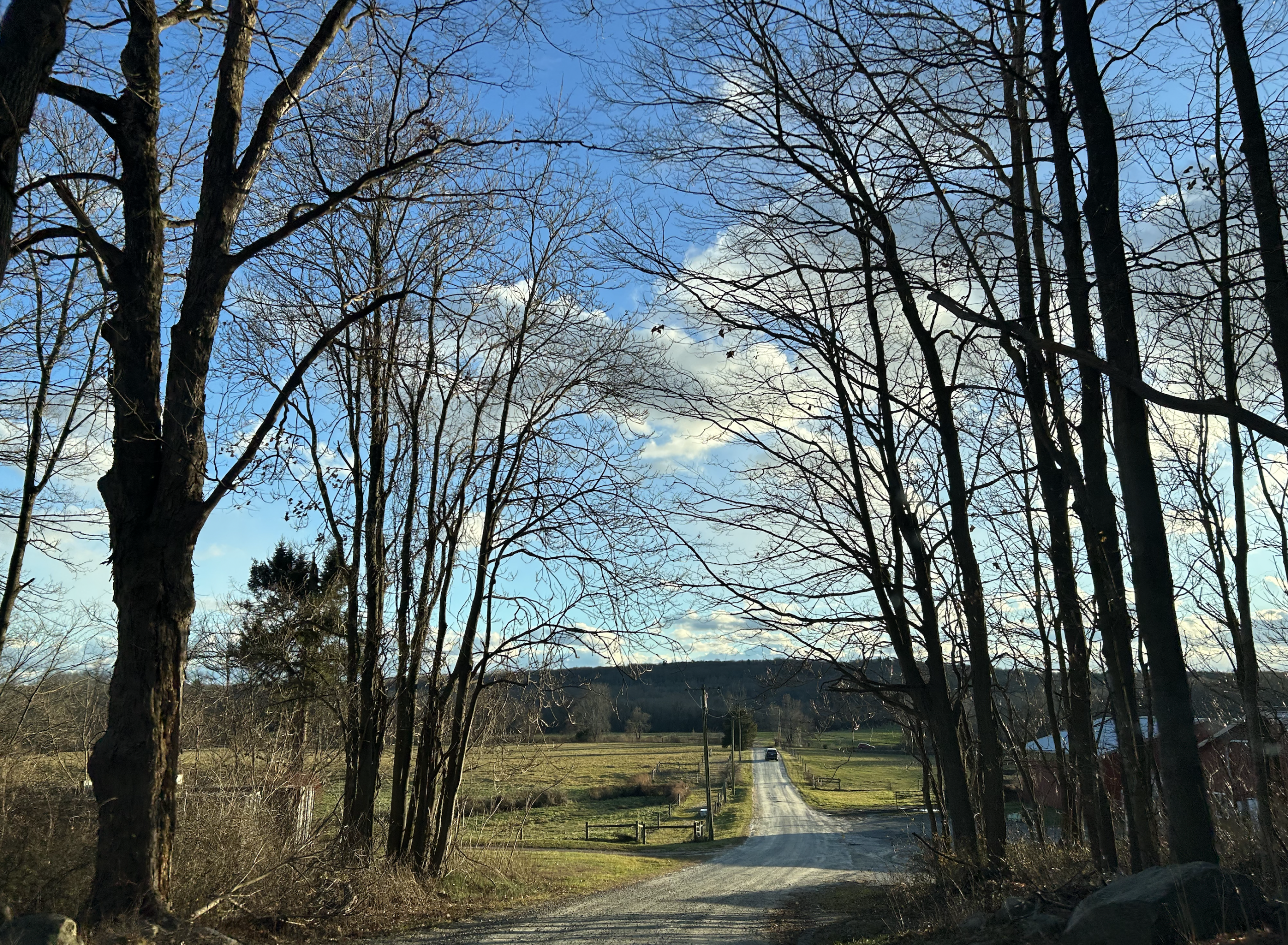
Over the river, through the woods. After the “goats in the road” signs, this view. Then a bevy of pastured beef cattle to the right

Stories found. People met. Context gained. Walk and explore and you will find stories so numerous it’s nearly impossible to write fast enough. Here are some.
Where cows once drank, Coginchaug Greenway.
— Moo Dog Press (@moodogpress.com) November 23, 2025 at 3:46 PM
Think of these sites as a library of lives. Because they are.

“Wind, rain and lichen have taken their toll, but the old stones are irreplaceable artifacts of the past. They are truly outdoor museums, as worthy of preservation as the museums that celebrate the town’s heritage around its equally ancient town green.”
Text: Alicia Wayland. Map: Lindy Brunkhorst Olewine. Graphics: Grace Sayles
Lebanon Historical Society 8/03
For those who marched off to fight, another thread to WPA and documentation.
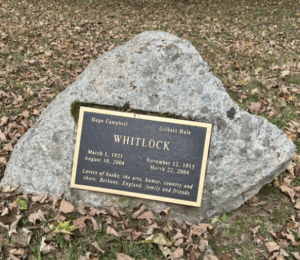
Whitlock. “Lovers of books, the arts, humor, country and shore, Bethany, England, family and friends.” Respect.
“At the request of the emeritus state archaeologist, Friends of the Office of State Archaeology, and Veterans of Foreign Wars (VFW) Post 3336 cemetery troopers, the Natural Resources Conservation Service (NRCS) staff conducted a ground-penetrating radar (GPR) investigation at Three Bridges Cemetery in East Haddam, Connecticut. Dr. Krista Dotzel, a Connecticut NRCS archaeologist, and Debbie Surabian, NRCS Soil and Plant Science Division national leader for standards and GPR operator, helped identify whether Asa H. Havens and his mother, Clarissa Havens, are buried in marked graves within the cemetery. This investigation was completed in accordance with USDA NRCS’s commitment to the protection and enhancement of our nation’s communities.
“…abbreviated story was written by Hilda Carter Fletcher and can be found online at findagrave.com. Irma Carper-Miller, a VFW Post 3336 cemetery trooper, shared further information about the story through discussions in the field and email, based on her research.”
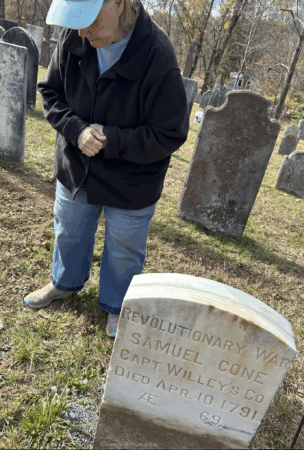
Irma Carper-Miller explains about stone, time, art, carvers, and respect.
USDA Natural Resources Conservation Services
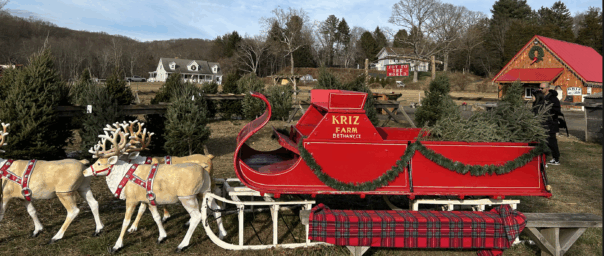
Kriz Farm in Bethany, CT. Draft horses (usually), fresh-cut trees and greens. Stop by Clover Nook on the way to or from this destination.
“Cemetery Troopers.”
Yes, during our conversation on site on East Haddam-Hadlyme, Findagrave.com was discussed. Because research can be done from anywhere, tracking family history, distant connections and/or adding names, images, details.
Did you know that users can request help through the site with an email including a name and burial information? Very early (prior to 1700) may not be included in listings and/or databases because when people interred, there were simple markers or no markers at all.
(On our ride home from an outing in Bozrah-Lebanon in Connecticut, the question came up about Native American burials, other early graves. How were these areas denoted? Cairns? Big rocks? Thinking again of Mamoosun and if his request was honored. Does anyone living know where the burial site was located?) Note: his name is spelled in various ways in listings, on signage.
“Native American New Englanders have a very deep history that was chronicled in their oral traditions. This deep history also has been confirmed by archaeological investigations. In Connecticut, the earliest known archaeology site is the Paleo-Indian Templeton site, located in Washington, CT and radiocarbon-dated to 10,200 years ago. … Wangunk tribe held claim to a huge swath of territory, and that territory was occupied by a substantial indigenous population continuously from PaleoIndian times well into the contact period. By the time of European settlement in 1633, over a dozen Wangunk villages were known to be located along the river: Poquonnoc (present Windsor Locks); Suckiog (present Hartford); Matianuck and Mattacomacok (present Windsor); Pyquag (present Wethersfield); Nayaug and Naubuc (present Glastonbury); Wangunk (present Portland); Mattabesek (Middletown); Coginchaug (present Durham); Cockaponset (present Haddam); Cossonnacock (present Haddam/Lyme area); south to Pattyquonk and Machemoodus (East Haddam) (Ives 2001, 2004; Yale Indian Papers 2015).” – Pre-colonial History of the Wangunk by Lucianne Lavin, Ph.D. of the Institute for American Indian Studies, which was presented at the panel event “Indigenous Middletown: Settler Colonial and Wangunk Tribal History” Dec. 5, 2015 at Wesleyan University.
Cemetery Collections & Resources
Cemetery Resources
The Charles R. Hale Collection
The Lucius B. Barbour Collection
Published Cemetery Transcriptions
Cemetery Art, Symbolism & Preservation.
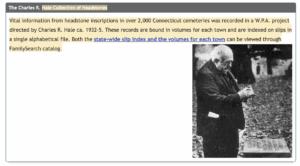
The Charles R. Hale Collection of Headstones
Vital information from headstone inscriptions in more than 2,000 Connecticut cemeteries was recorded in a W.P.A. project directed by Charles R. Hale ca. 1932-5. These records are bound in volumes for each town and are indexed on slips in a single alphabetical file. Both the state-wide slip index and the volumes for each town can be viewed through FamilySearch catalog.
“Admire the world for never ending on you as you would admire an opponent, without taking your eyes off him, or walking away. …Do not hoard what seems good for a later place in the book, or for another book; give it, give it all, give it now. The impulse to save something good for a better place later is the signal to spend it now. Something more will arise for later, something better. These things fill from behind, from beneath, like well water. Similarly, the impulse to keep to yourself what you have learned is not only shameful, it is destructive. Anything you do not give freely and abundantly becomes lost to you. You open your safe and find ashes. After Michelangelo died, someone found in his studio a piece of paper on which he had written a note to his apprentice, in the handwriting of his old age: ‘Draw, Antonio, draw, Antonio, draw and do not waste time.'”
–Annie Dillard
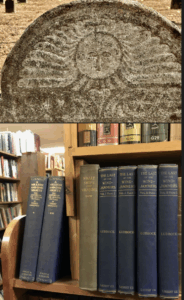
“Archives Veterans Works Progress Administration (WPA) Cemetery Records were created in 1939-1940 by the Works Progress Administration as part of its Historical Records Survey. The Cemetery Records collection consists of two parts – cemetery cards and cemetery maps. Used together, these resources provide details such as a veteran’s name, location of residence, date of birth/death, details of military service, and/or cause of death. Burial site and exact location of grave are given in most records. A user’s guide is available that describes in detail how to use the veteran cards and maps and provides more information on the use of record numbers to identify veterans.
“Please note that some mistakes have been discovered in the records made by the WPA. However, because we are not the creator of these records, we cannot alter any of the entries or the actual records themselves. Therefore, we welcome comments from patrons on individual records noting any discovered mistakes and informing us of corrections.
“Search tip: If your name search is not successful, try browsing through all the records alphabetically. ANY name may be spelled differently than you expect due to a variety of reasons involving the original document or the transcription and data entry.”
Color and scent, cheer, beauty, evergreen.
More? CT Gravestone Network (CGN) was founded in 1998 by Director Ruth Shapleigh-Brown via support by local Association for Gravestone Studies members. Dr. James Slater author of the book “The Colonial burying Grounds of Eastern Connecticut and the Men who made them” and the Connecticut State Archaeologist emeritus Dr. Nicholas Bellantoni.


Editor’s note: Love this time of year. Read Charles Dickens, cold, snow, cozy wood stove warmth. Short days, time for work, rest, contemplation. Reading. Woodshavings in the barn, hay. Related read: Dr. Mütter’s Marvels: A True Tale of Intrigue and Innovation at the Dawn of Modern Medicine by Cristin O’Keefe Aptowicz. A portion of this original story has been archived and is no longer online.
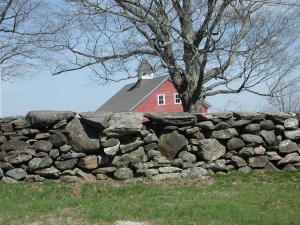
Cemeteries, graveyards, burial sites. Think of these as libraries of lives. Outdoor exhibit of carver’s skills (consider one wrong tap tap and errors cannot really be corrected). Research outdoors in amazing settings for history, genealogy, relationships. And lead to great places for lunch, gifts, explorations.
Personal must: A canine companion. Consider please (linked): Where the Love Is Rescue, Inc. Island of Misfits (Alabama; a dedicated crew transports to Connecticut and other NE locations).
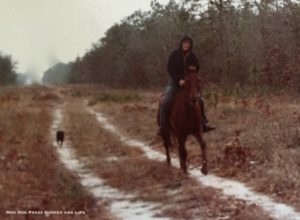
Remember. I will. My first dog, the one I knew no one would adopt. From a pound in NW Florida; Her littermate was so sick. Annie, love. You teach me still.
Here’s to business and life, as new chapters unfurl.
“The greatest danger for most of us is not that our aim is too high and we miss it, but that it is too low and we reach it.” –Michelangelo
Editor’s note: This story has been updated.