
Venture Smith: Determination, Family, Work To Freedom, His Farm
“Those who say it can’t be done are usually interrupted by others doing it.” James Baldwin
Venture Smith found a way to freedom and to then work to buy and unite his family, acquire land, then run a thriving farm, business. His story is amazing, inspirational.

The Venture Smith Stone “442 pounds” (!), a a still from theStanton Davis House; video by the late William Hosley, 1:39 in video. Linked to source.
“I was born at Dukandarra, in Guinea, about the year 1729. My father’s name was Saungin Furro, Prince of the tribe of Dukandarra.”
That’s the opening line of Venture Smith’s “A Narrative of The Life And Adventures of Venture, A Native Of Africa: But Resident Above Sixty Years in the United States of America,” the earliest slave narrative in the United States, published in 1798.
The Library has an original copy of the 32-page pamphlet, preserved in the Rare Book and Special Collections Division. Publishing by the Charles Holt company, it is still in print 223 years after publication (you can also read it online for free) and is the basis for biographies of Smith and academic studies of the era.
Smith’s narrative is a rare account of slavery in Colonial New England, one of only a few ever published. It’s also one of the very few records of enslaved people who told of their lives in Africa, among them the handwritten autobiography of Omar ibn Said, also preserved at the Library.
— from (2021) Library of Congress by Neely Tucker with Mark Dimunation, chief of the Rare Book and Special Collections Division.Another excerpt: “He told her that their young VENTURE had become so stubborn that he could not controul him, and asked her what he should do with him. In the mean time I recovered my temper, voluntarily caused myself to be bound by the same men who tried in vain before, and carried before my young master, that he might do what he pleased with me. He took me to a gallows made for the purpose of hanging cattle on, and suspended me on it. Afterwards he ordered one of his hands to go to the peach orchard and cut him three dozens of whips to punish me with. These were brought to him, and that was all that was done with them, as I was released and went to work after hanging on the gallows about an hour.”
The 28th Annual Venture Smith Day at First Church of Christ, Congregational in East Haddam, is Saturday, Sept. 7, 1 to 4 p.m. A wonderful program featuring national speakers is planned. You can also visit the Venture Smith exhibit at East Haddam Historical Society from noon to 5 p.m., 264 Town St.The sign at Venture Smith (and wife, family) gravesite.
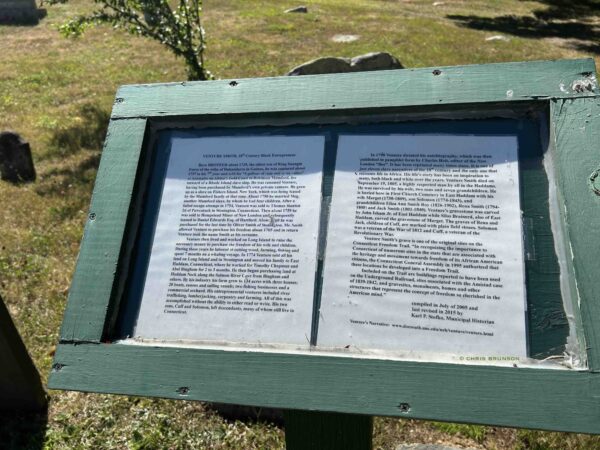
This year’s speakers include Akeia de Barros Gomes, director of the Edward W. Kane and Martha J. Wallace Center for Black History at the Newport Historical Society, who will present “There’s a World of Something in This: Enslavement, Identity, Freedom-Making in Newport, Rhode Island.” Genealogist John Mills, president of the Connecticut-based nonprofit Alex Breanne Corp., will present “Refocusing the Lens of Reverence.” East Haddam municipal historian Karl P. Stofko, a Smith family genealogist since the 1970s, will talk about “What’s New with Venture & Three Justices of the Peace Who Assisted Venture in His Land Purchases.” Stofko, who received the 2022 Award of Merit for Individual Achievement from the Connecticut League of History Organizations, co-authored “A Brief History of East Haddam, Connecticut.”
He is also a member of the Freedom Trail Committee and chairman of the annual Venture Smith Day celebrations. To learn more visit the site of East Haddam Historical Society, and theirs events page (also on Facebook). There is also a virtual museum visit link listed. Quilts, refreshments; open to the public.
To pay respect to him his family–a recent visit. (There was also a related goal in visiting this resting place site, part of the Freedom Trail in Connecticut.)
“Sacred to the Memory
of Venture Smith an
African tho son of a
King he was kidnapped
& sold as a slave but by
his industry he acquired
Money to purchase his
Freedom who died Sept 19th
1805 in ye 77th Year of his
Age”Inscription: www.findagrave.com/memorial/668…
— Moo Dog Press (@moodogpress.com) August 19, 2025 at 8:45 PM
Real life is more amazing than fiction. Though he could not write, Venture Smith found a way to get his incredible life story told, published, ferried into the future. And faced more obstacles in his life than most of us ever will along the way.
“If only Venture Smith could write.” — Introduction, first line in “Making Freedom: The Extraordinary Life of Venture Smith” by Chandler B. Saint & George A. Krimsky (Wesleyan University Press 2009).
A video by the late William Hosley that includes how intertwined history stands–the Stanton Davis House–and the late Whit Davis interviewed and led the tour.
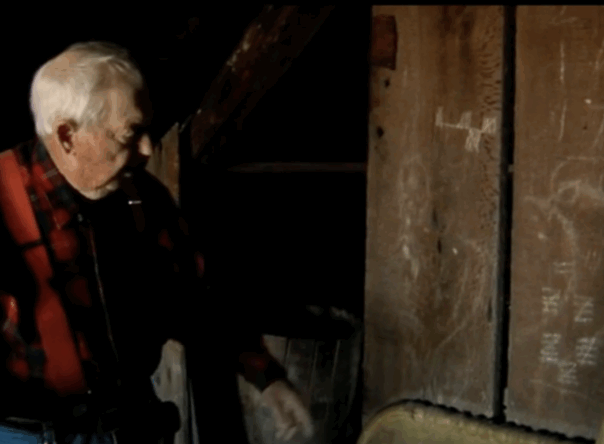
The late Whit Davis leads a tour into the attic where Venture Smith lived, and perhaps drew this pregnant woman, his wife. Stanton Davis House Video, 1:55 by
William Hosley, linked to source.
Venture Smith’s (maybe) sketch in the attic:
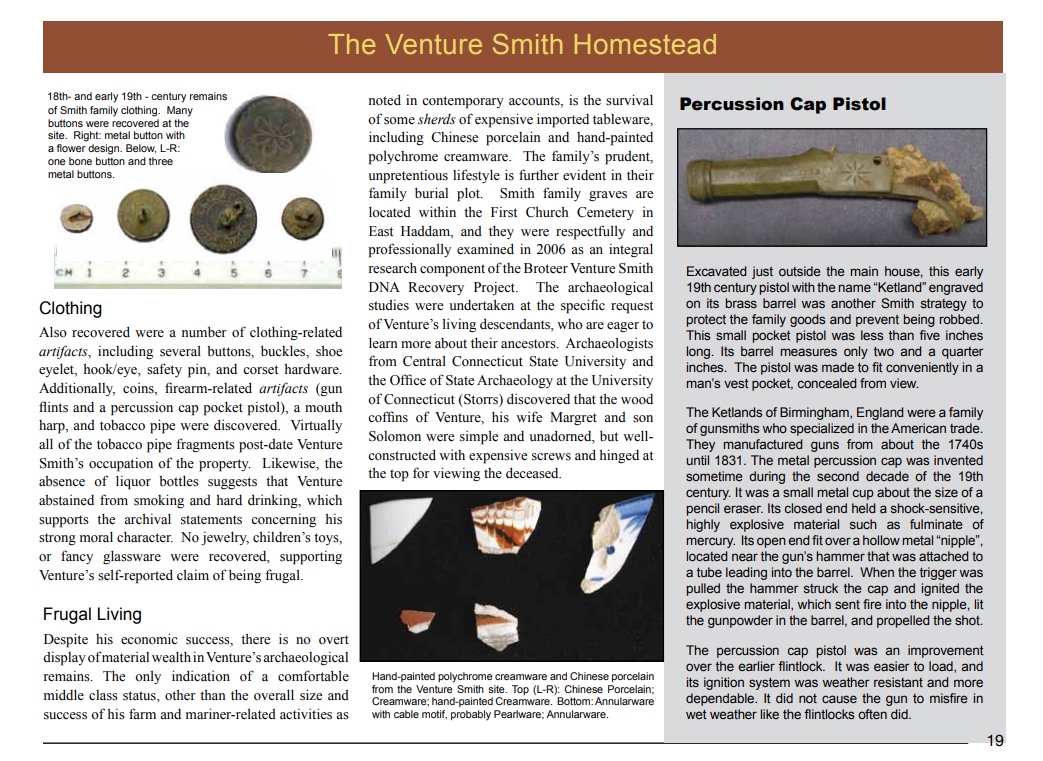
Page 19 from the IAIS Museum booklet Venture Smith Homestead online as a PDF, linked to this image.
From a rich resource PDF booklet by Institute for American Indian Studies (IAIS) Venture Smith Homestead:
“Venture dictated his autobiography to a white schoolteacher and the story was published in New London, Connecticut in 1798. Entitled A Narrative of the Life & Adventures of Venture, a Native of Africa, but Resident above Sixty Years in the United States of America, related by himself, it is one of the few slave narratives that discusses in some detail life in Africa as well as the life of an African captive in Colonial New England. Town histories in Connecticut and Rhode Island relate stories of his unusual physical strength and courage. He has been referred to as a ‘black Paul Bunyan.’ He was six feet two inches tall, weighed over 300 pounds, and measured six feet about the waist.
“He could lift a tierce of molasses, or carry seven bushels of salt. … once, between sunrise and sunset, he threw the trees and cut and laid up 16 cords of wood (Rev. Frederic Denison 1878:119).”
Related, a new book published by Wesleyan University Press:
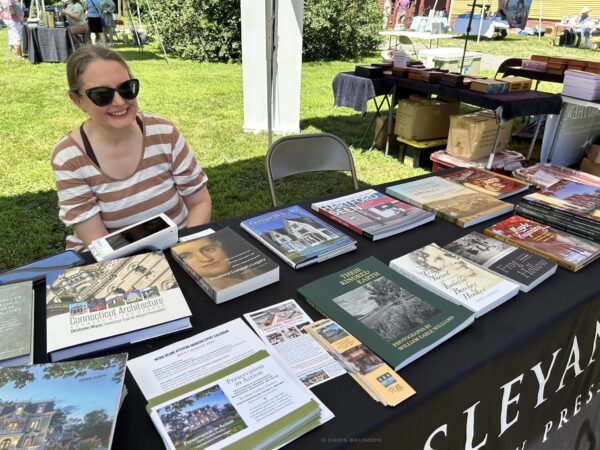
The book is right there on the table, this is how it was found. From the first-ever CT Book Walk Day in Old Wethersfield. Stephanie Prieto, Wesleyan University Press–so grateful you posted on Bluesky in the morning–helped us to find you and learn about these great books. Very well attended this event. Many families too.
Architecture, Black history, O’Rourke’s Diner, Florence Griswold connections, preservation. Prudence Crandall. David Leff. Hartford.
“Mentored in the 1970s by the famed #photographer Walker Evans, who had a home in Lyme, Williams attended the Yale School of Art at Evans's suggestion.”
— Moo Dog Press (@moodogpress.com) August 20, 2025 at 10:05 AM