
October Houses + Apples And Pumpkins + New Trails
“Go around with your eyes like a camera. Don’t lose it by talking. Go and listen. And work!” –Jimmy Breslin
An old favorite of a landmark, gone.
The cupola above the foliage, a glimpse of the farmhouse. Not there anymore.
Context:
Time and change.
Research to place now with then. Houses gone, but not forgotten.
“On June 10-12, 2026, Hal Borland’s home on Weatogue Road in Salisbury, CT was torn down. Current owners have built a new residence on the property and Borland Farm is history. Hal and Barbara Borland purchased the home in July of 1952 after a serious illness…”
📷 halborlandamericancountryman.com
— Moo Dog Press (@moodogpress.com) September 24, 2026 at 10:45 AM
And one of the oldest houses in Meriden, CT–right in front of my imagination.
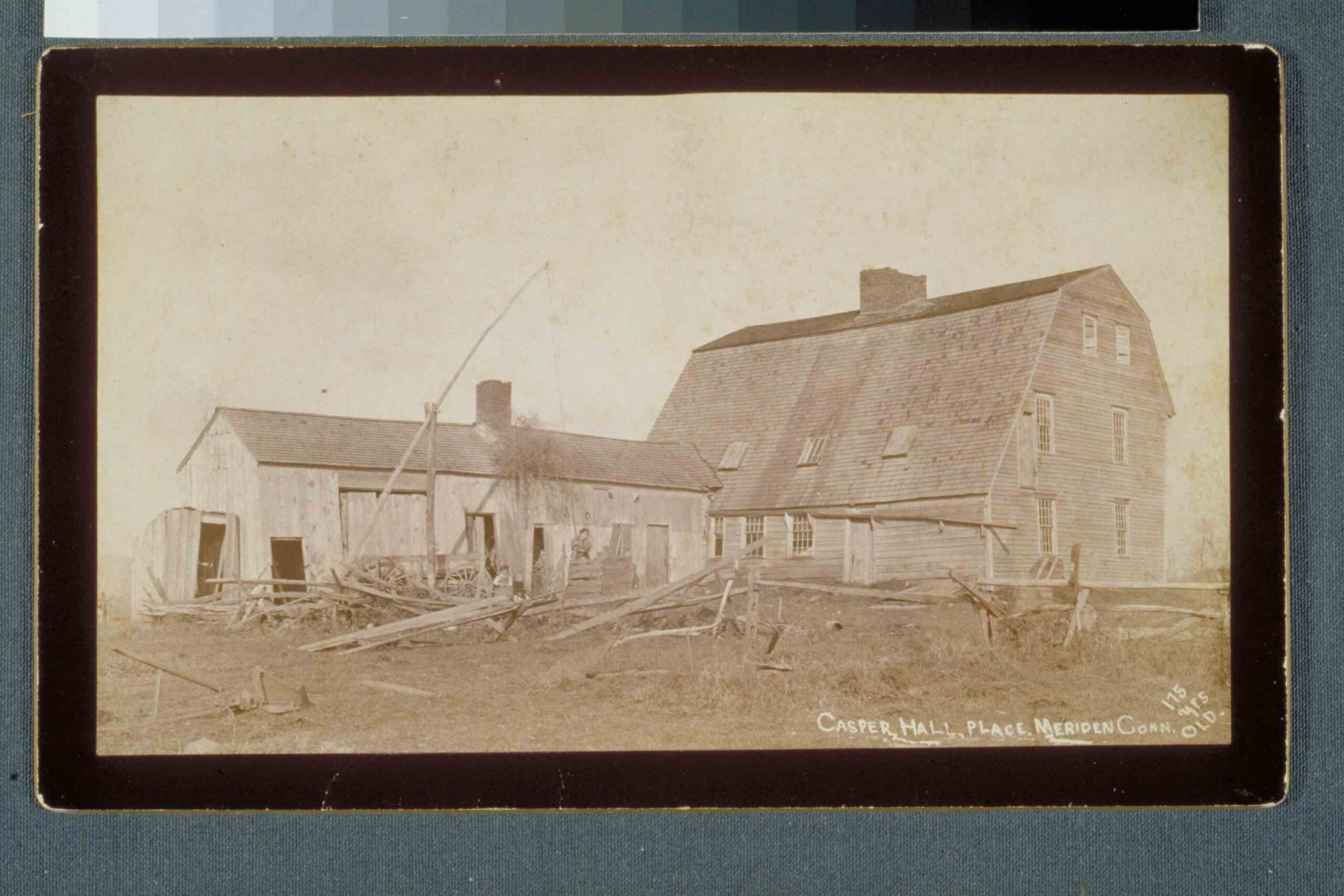
Note the gutter slanted to drain water. Image is linked to source, Connecticut Digital Archive where viewers may zoom in on details. Note the incredible detail in this image. A chimney’s been nibbled away over time. Inscribed on front “Casper Hall Place Meriden, Conn. 175 yrs old.” Rev. Samuel Hall built the house in 1762 near Preston Avenue on Old Liberty Street as a wedding present for his son, Breton. Lyman Hall, signer of the Declaration of Independence and Col. Street Hall, revolutionary war hero were cousins of Rev. Hall. Date is 1890, Meriden (Conn.) Photographer Burton H. Hubbell via Connecticut Historical Society/Connecticut Digital Archive.
How was the house sited? Will guess looking at the magnificent view of two nearby traprock hills, plus the waters of Black Pond and what used to be an adjacent lively swamp backed up to the talus from the basalt cliffs above. Which is ideal habitat for copperheads that love the sun-warmed scree; many pockets beneath rock for denning. Ideal habitat near food sources as well.
Note the ell, outbuilding for livestock, wood? So unusual the height of the home. Windows. That roof.
Burton Hubbell. (Thank you for your work across time.) Photographer who sent images from the past forward in time to the keepers who preserve and present these treasures. Time travel. From the moment he captured an image to right now. Imagine scanning his image to make a three-dimensional object. Now site it on location as a holographic display. Then ground penetrating radar and an overlay of objects found. An archaeological exploration, dig under auspices of the state archaeologist.
The late Richard McBride, a living library when he lived in Meriden, Connecticut, told of Parker Road being Liberty Street–a comment that seemed incredible at the time, decades ago. Not anymore. Old maps show and tell; deep reading helps with understanding what has changed. The memory of reading and doing research for local history, a story then flickered through my mind. A book. The following footnote, which applies to the structure pictured above.
4. This old house was torn down a year ago. If one rides to the end of the electric car line on East Meriden and then walks up the road running to the north, one is on Preston Avenue. At the top of the hill, about an eighth of a mile from the car tracks, one reaches this old highway running east and west. That part of the highway east of Preston Avenue is still in use and climbs a hill, at the top of which on the south side of the road stood the old Casper [sic] or Brenton Hall place. From this point the view is beautiful; in the south extends the range of Besett or Beseck Mountains with Black Pond at the foot mirroring the rugged cliffs in its sombre waters, while in the west a charming stretch of meadow, wood and vale ends with the grand range of the Hanging Hills. About a half a mile to the west on the same old highway stands the John Yeamans house with its old stone chimney still undisturbed (taken down since this was written). This house was build by Daniel Baldwin about 1730, Chimney Hill derives its name from the old stone chimneys of two or three old houses, left standing after the houses had disappeared. These houses also faced this road. Several old houses once stood on this street that have completely disappeared.”
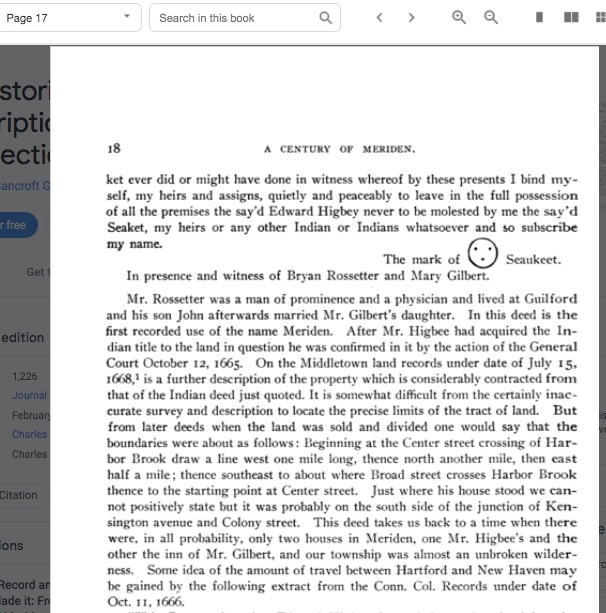
Page 17 via Google Books, digital library. For a clear reading, image is linked to the book online.
Don’t forget to Walktober–this event has something for everyone in The Last Green Valley.
A day. A year; then five or 20. Ride on, keep walking. Pick some apples, pears, pumpkins along the way.
Warm apple pie. Or some apple crisp, crumble.
A new map of trails to follow.
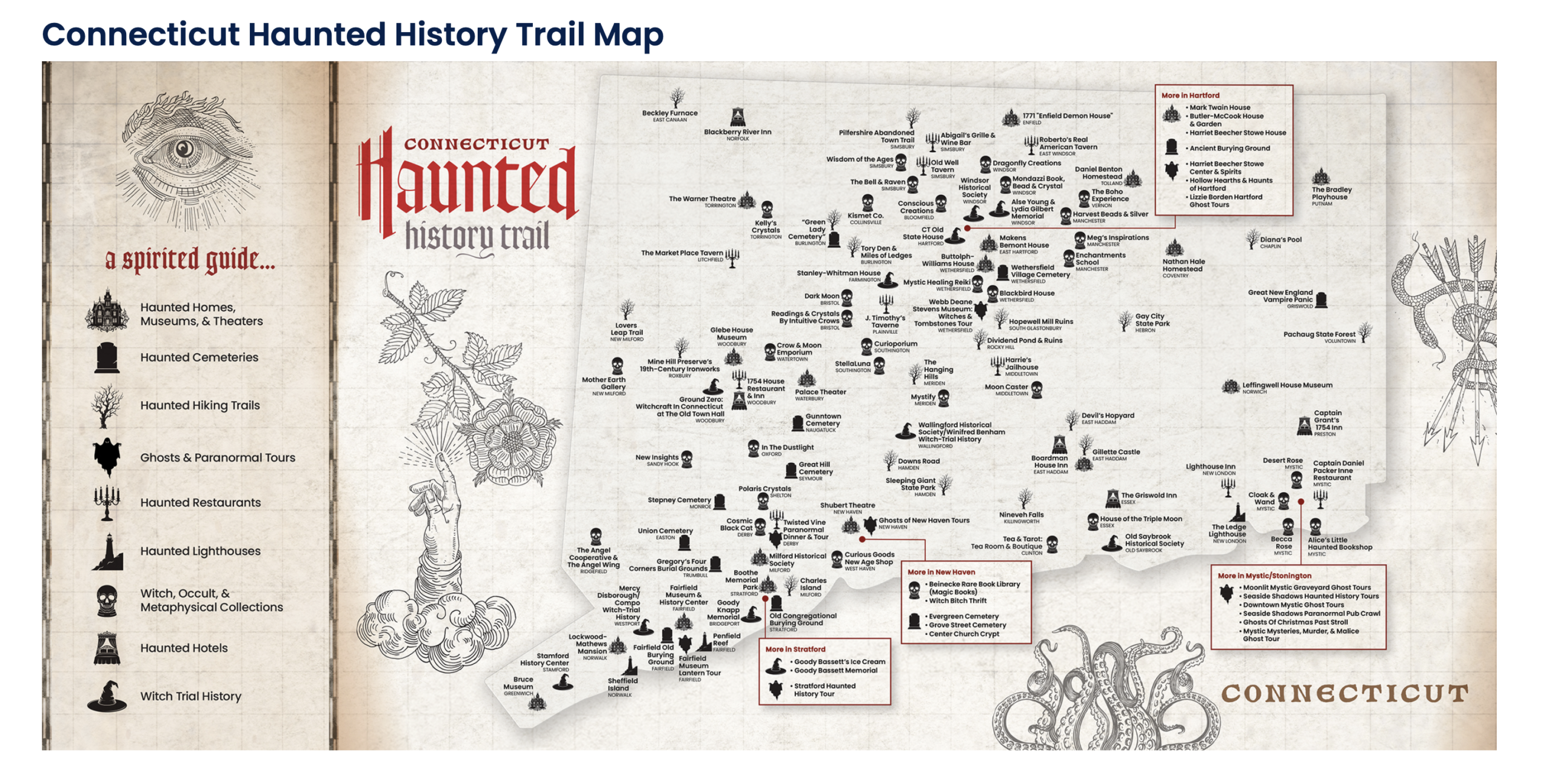
Let’s go.
Highlights include:
Connecticut Witch Trial History: Decades before the infamous trials in neighboring Massachusetts, Connecticut was accusing and executing people for witchcraft.
Hartford Ghosts: Local historians, storytellers, and paranormal investigators lead the way through legendary locations.
Haunted Hiking Trails: Venture into forests where strange formations, crumbling foundations, and mysterious encounters have inspired generations of stories.
History in Cemeteries: Wander among ancient markers and shadowy crypts where the names may be fading, but the stories refuse to be forgotten.
“Change is a measure of time and, in the autumn, time seems speeded up. What was is not and never again will be; what is is change.”
Edwin Way Teale
— Moo Dog Press (@moodogpress.com) October 1, 2026 at 9:01 AM
Psst. Not far away now, another event. The Fiber Festival of New England, Nov. 7-8, 2026. Presented by Eastern States Exposition in partnership with the New England Sheep & Wool Growers Association. Met someone at The Big E who plans to attend; hope to see him there and knit some more.
Pick up the circs, knit a row.
— Moo Dog Press (@moodogpress.com) October 2, 2026 at 3:44 PM
Editor’s note: This story has been updated.