
New Departure Ball Bearings, Rolling On From Meriden, Connecticut
“The question is not what you look at, but what you see.” Thoreau
Like a pencil sharpener for the mind, Bluesky (no longer on Twitter) shards of comments, replies, a mix of literature, art and especially news from across the planet before the 6 p.m. news–is a workout. An exercise, flex and provoke writing. Thoughts float up and are caught, connections made. A daybook for the digital era. To learn. Libraries, Melville, Chaucer. Book recommendations. Indexers, authors, publishers. And all depends on how the feed is curated. Input key search words, scan the results. Import, export. Stop. Get thee to a keyboard, let the words flow.
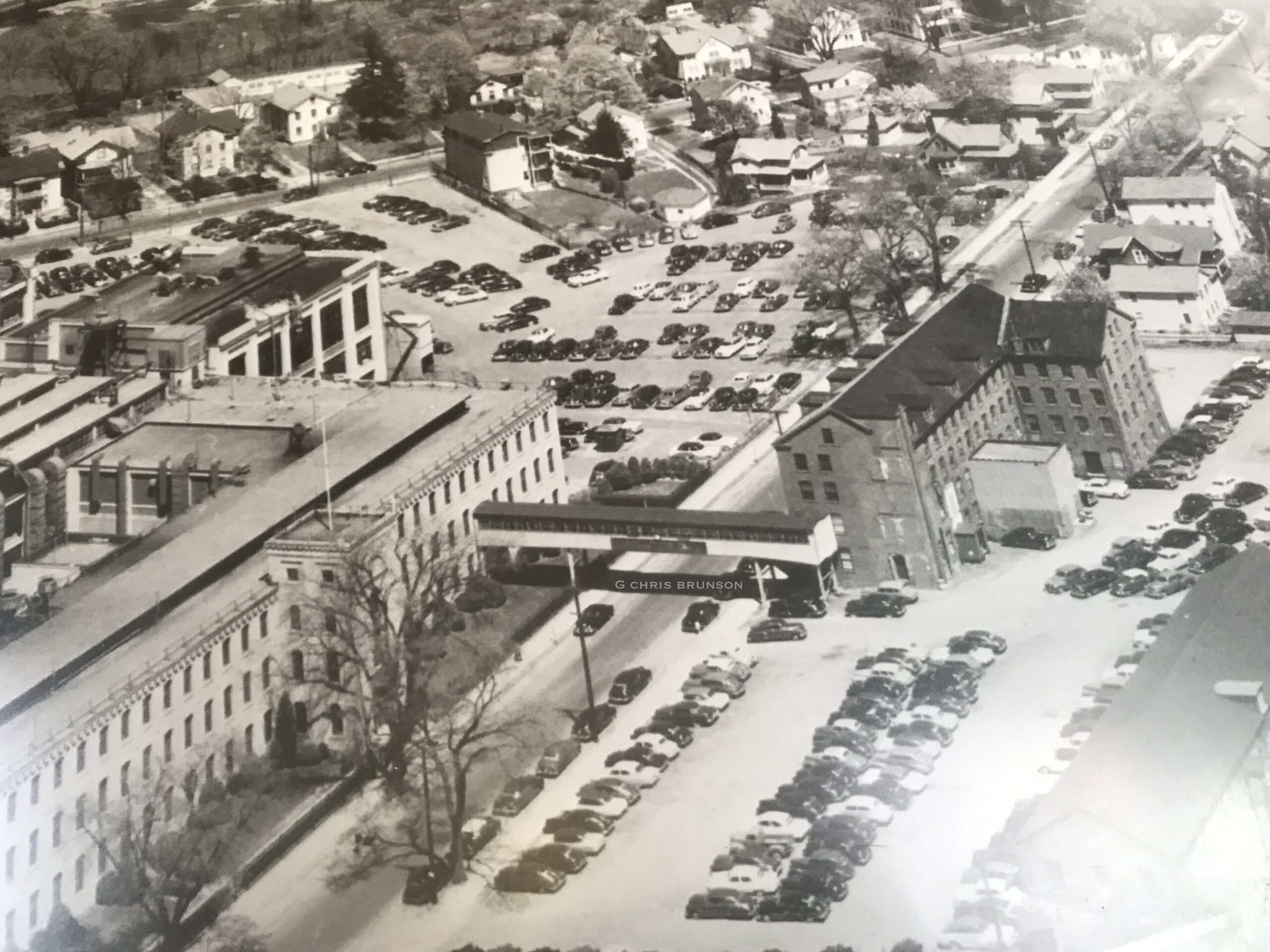
What was there. That bridge across Pratt Street. Just look at the details of what was New Departure, Meriden, CT. Another chapter of this structure, linked to this image.
“New Departure Division World War Two / WWII Production Numbers / Statistics: New Departure continued to make the same product line during the Second World War as it did previously which was roller bearings. Available data shows that in 1942 it made 67,376,111 bearings and in 1943 it made 85,321,043 bearings for the war effort. Estimating that it made another 85 million in 1944 and then 50 million in 1945 as the war contracts were cancelled in August of 1945 New Departure probably made on the order of 287 million bearings for thousands of different uses in World War Two. More can be learned about those military applications and its very interesting early history by reading the 1943 pamphlet below.
“Bearing are ubiquitous. They are used everywhere but we don’t really think about them as they are invisible in rotating and oscillating a machinery.
“New Departure Division, Plant A, Bristol, CT won the Army-Navy “E” award four times.
“New Departure Division, Plant D, Meriden, CT won the Army-Navy “E” award four times.”
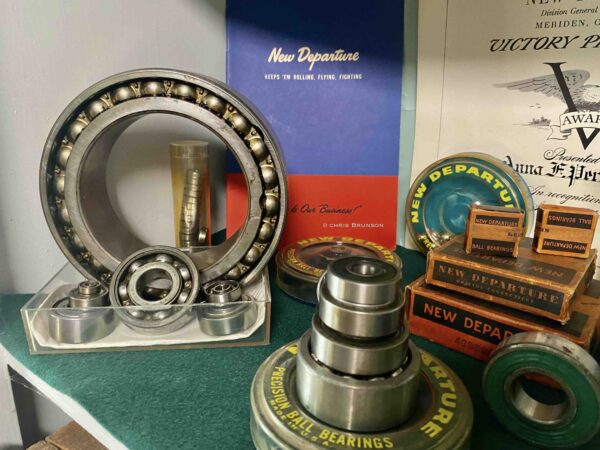
Cups and cones, assemblies. Promotional material. New Departure display detail, Meriden Historical Society from an interview and tour.
It’s where my parents met, courted. (“He had a car, and was back from the service.”) My mother, who also documented the donut-headed man (and knew who was inside the costume to promote eating fresh donuts inside the store) with her camera. Kresge’s on Colony Street and West Main (two entrances), Meriden, Connecticut. Her stories captured and recorded, transcribed. The first time her photo of that iconic image (a person with a giant donut head!) was published was in The Gazette, Durham. The original, a family treasure. (More about that another time.)
Driving west, passing that building to the left, thinking of the name “Pratt” because of the former factory to the right–and connections recently discovered to Deep River, the ivory trade, Africa. The interstate highway bisected much of Meriden. City Park got its nose lopped off. Hubbard Park’s gorgeous bucolic beauty marred by the constant noise of vehicular traffic. As one of those vehicles, appreciate the ease of getting anywhere fairly easily from Meriden. But noting that the almost ever-present hum as one of the costs to doing so.
What was one of things manufactured at the other factory on Pratt Street (now interrupted by the highway)–something sourced from a massive incredible life form halfway around the world. Combs of ivory. One use? To carefully comb hair, find nits and kill them.
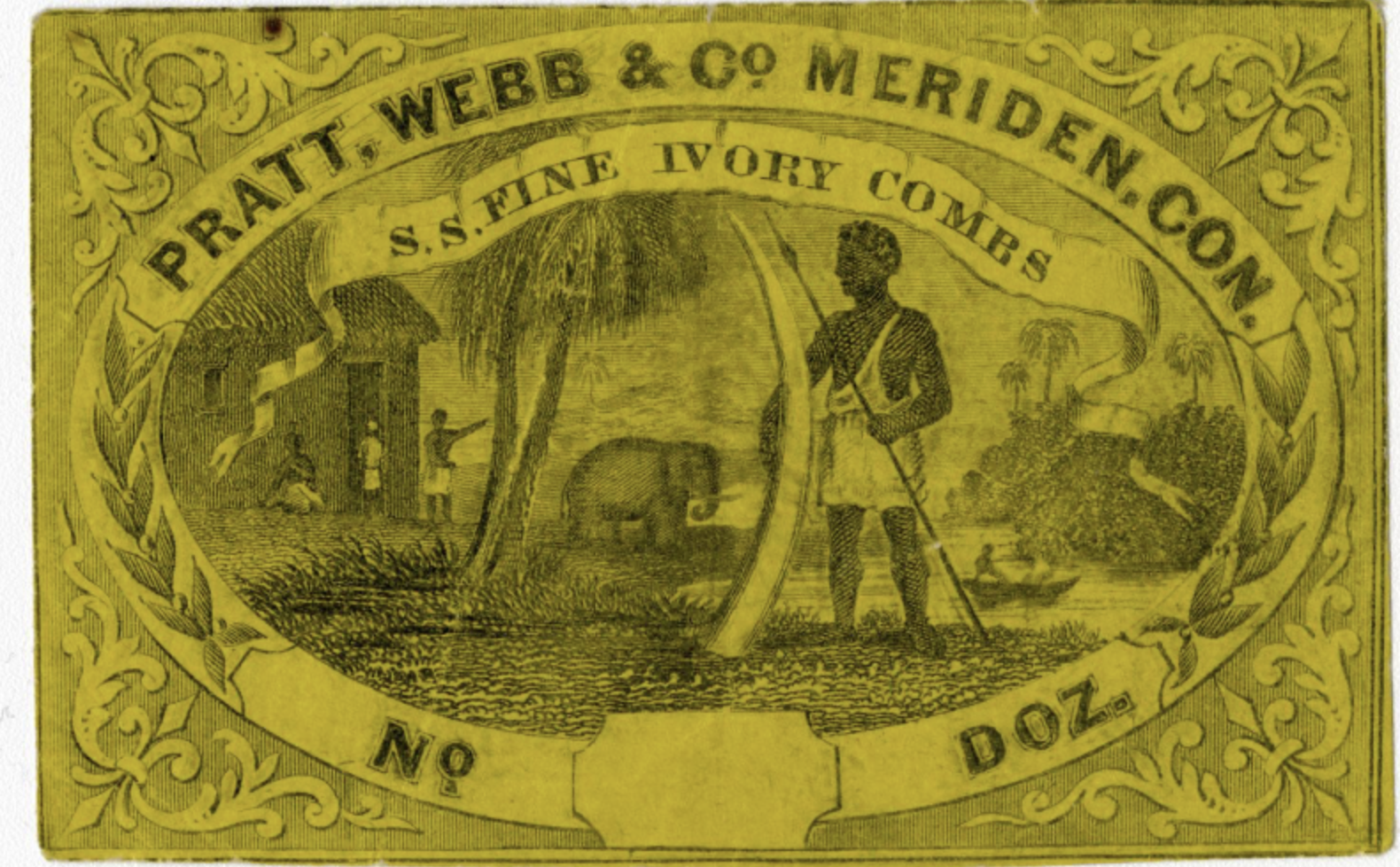
Walter Webb & Co., Meriden, Connecticut, Ivory Combs, about 1849. Label for Pratt, Webb & Co., located in Meriden, Conn., for S.S. Fine Ivory Combs. From Connecticut Museum of Culture and History collections, linked to source.
Julius Pratt, buried in West Cemetery, Meriden. From Find-A-Grave features an image of Pratt and aerial of his factory): “Son of Deacon Phineas and Hepsibah Pratt, Julius Pratt was an early manufacturer of ivory combs in Meriden, CT. He was also one of the pioneers in the manufacture of cutlery, later branching into making piano keys. He was good at making decisions and acted on them promptly. During the Civil War when he was urged to support the South as it would be good for business, his response was ‘If the people of the South do not want to buy our Meriden combs because of what we think, then let them go lousy.’ [in those days combs were necessary to remove lice. Two-thirds of the combs made in the United States were made in Meriden].
“Pratt was a director in the Home National Bank of Meriden since its beginning. Served in the CT State Senate.
“Both he and his partner, Fenner Bush, signed the 1836 statement of principles of the Meriden Anti-Slavery Society.” (There’s a little bit of irony in this.)
Also see: https://connecticuthistory.org/ivory-cutting-the-rise-and-decline-of-a-connecticut-industry/
“Depending on where hunters and buyers obtained the tusks, they might need to be carried for hundreds of miles to a port. Missionaries from Europe, in Africa to spread Christianity, left vivid accounts of the suffering of ivory’s human porters. Though precise figures are not available, David Livingstone, the famous Scottish physician and clergyman who spent decades in Africa, violently opposed the use of enslaved workers and is said to have estimated that five Africans died for every tusk moved to the coast for export. The American Civil War created some pressure to end slavery in Africa, but it continued there through 1897.”
By Donald L. Malcarne, a historian of the lower Connecticut River Valley and a past president of the Essex Historical Society, and Brenda Milkofsky, who curated the exhibition, From Combs to Keyboards: The Ivory Cutting Industry in the Connecticut Valley, while Director-Curator of the Connecticut River Museum in Essex, CT.
Switching topics, but related to connections found.
There once was a soft much-desired doll with bendable limbs–one of many but this one picked out from the rack at Upham’s on Colony Street. Left behind that day with a promise (probably to get me away) to come back sometime and get it. Then, a fire. Oh no.
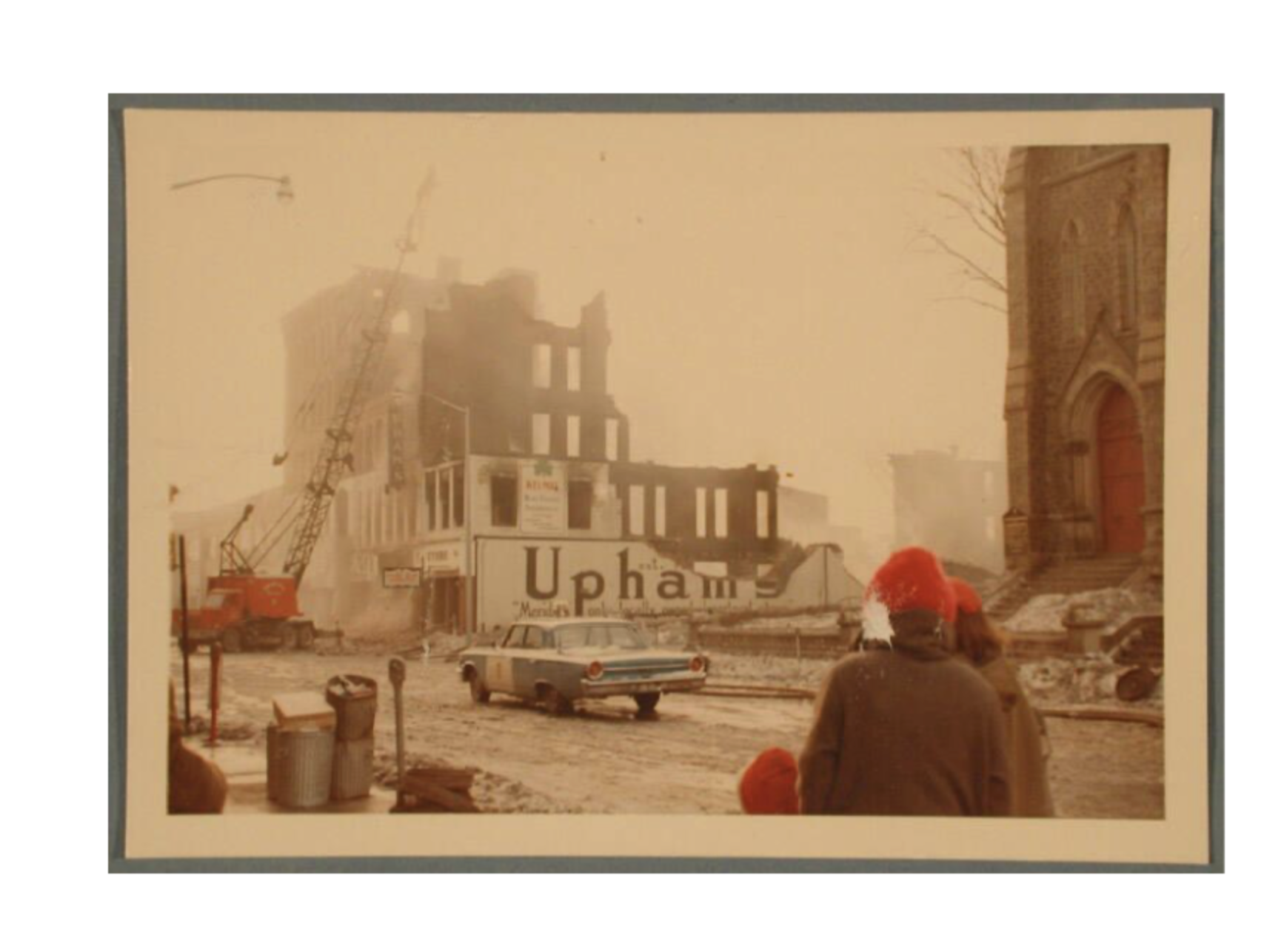
Aftermath of Fire at Upham’s Department Store, Meriden photographed by A. K. Rettenmeyer 1965. Color photograph on Kodak paper. Gift of Carl W. Rettenmeyer. A crane looms over the ruins of a burned-building, of which only the walls remain standing. A painted sign on a wall reads, “Upham’s / Meriden’s only locally-owned department store”. Other signs read, “KEL-MAX / Real Estate / Insurance” “FREE 2-HR / PARKING”. An automobile, possibly a taxi cab, is on the street, which appears to be snow-covered. Trash cans and a parking meter are on the sidewalk in the left foreground. Part of a Gothic church is visible at the right. Three people in the right foreground wear knit caps. Information and image: Connecticut Museum of Culture and History collections, linked to site.
The late Carl Rettenmeyer donated the image, grateful. Meeting him and his wife at Hubbard Park’s BioBlitz after doing a story about the UConn Museum of Natural History–that’s another memorable experience of a life. The life forms contained in soil; ants. His knowledge.
Back to New Departure, which was a hub of the city, state, region.
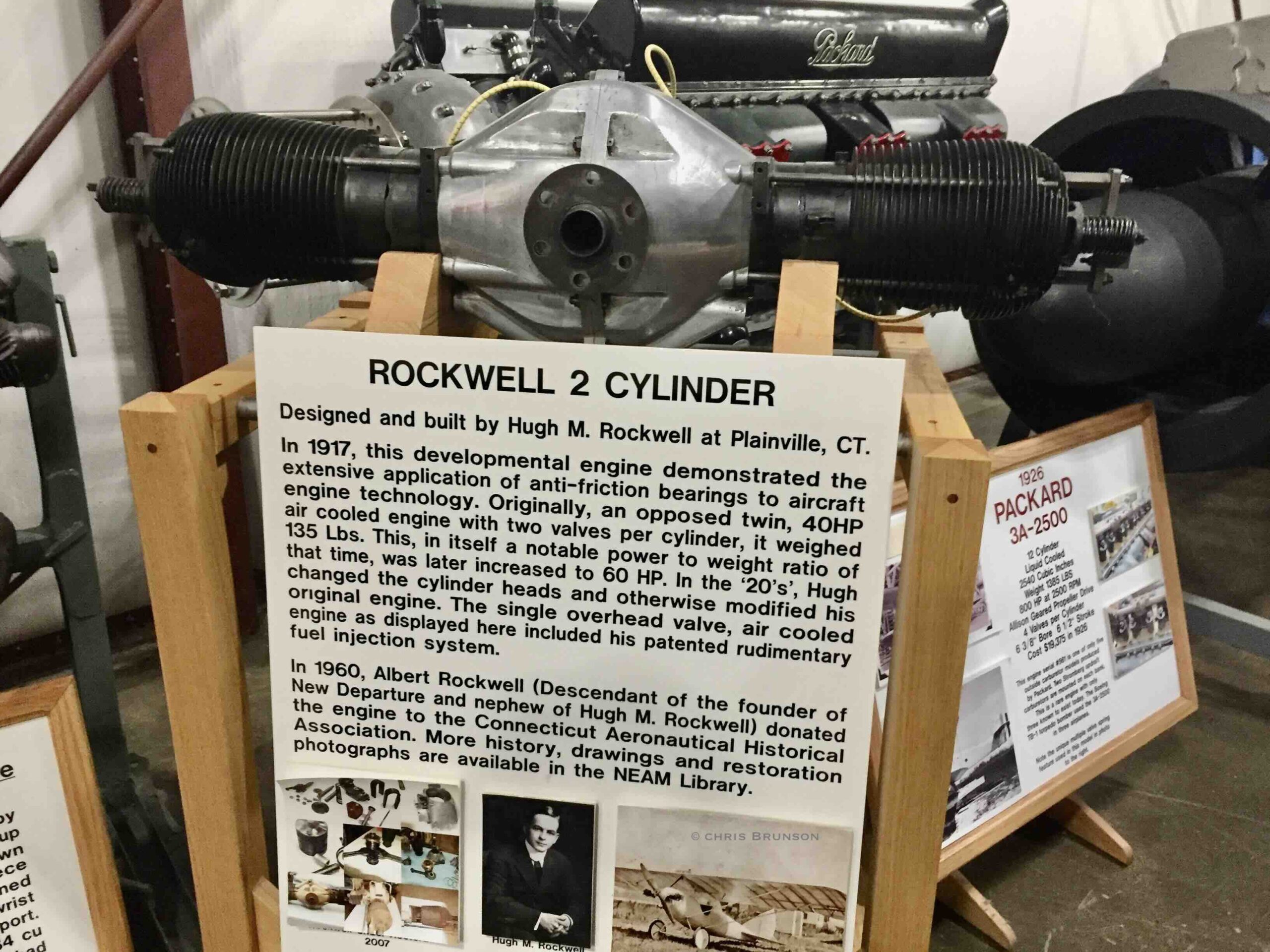
ROCKWELL 2 CYLINDER
Designed and built by Hugh M. Rockwell at Plainville, CT. In 1917, this developmental engine demonstrated the extensive application of anti-friction bearings to aircraft engine technology. Originally, an opposed twin, 40HP air-cooled engine with two valves per cylinder, it weighed 135 Lbs. This, in itself a notable power to weight ratio of that time, was later increased to 60 HP. In the ’20’s’, Hugh changed the cylinder heads and otherwise modified his original engine. The single overhead valve, air cooled engine as displayed here included his patented rudimentary fuel injection system. In 1960, Albert Rockwell (Descendant of the founder of New Departure and nephew of Hugh M. Rockwell) donated the engine to the Connecticut Aeronautical Historical Association. More history, drawings and restoration photographs are available in the NEAM Library. Image by Chris Brunson, also from a memorable interview and tour of the New England Air Museum in Windsor Locks.
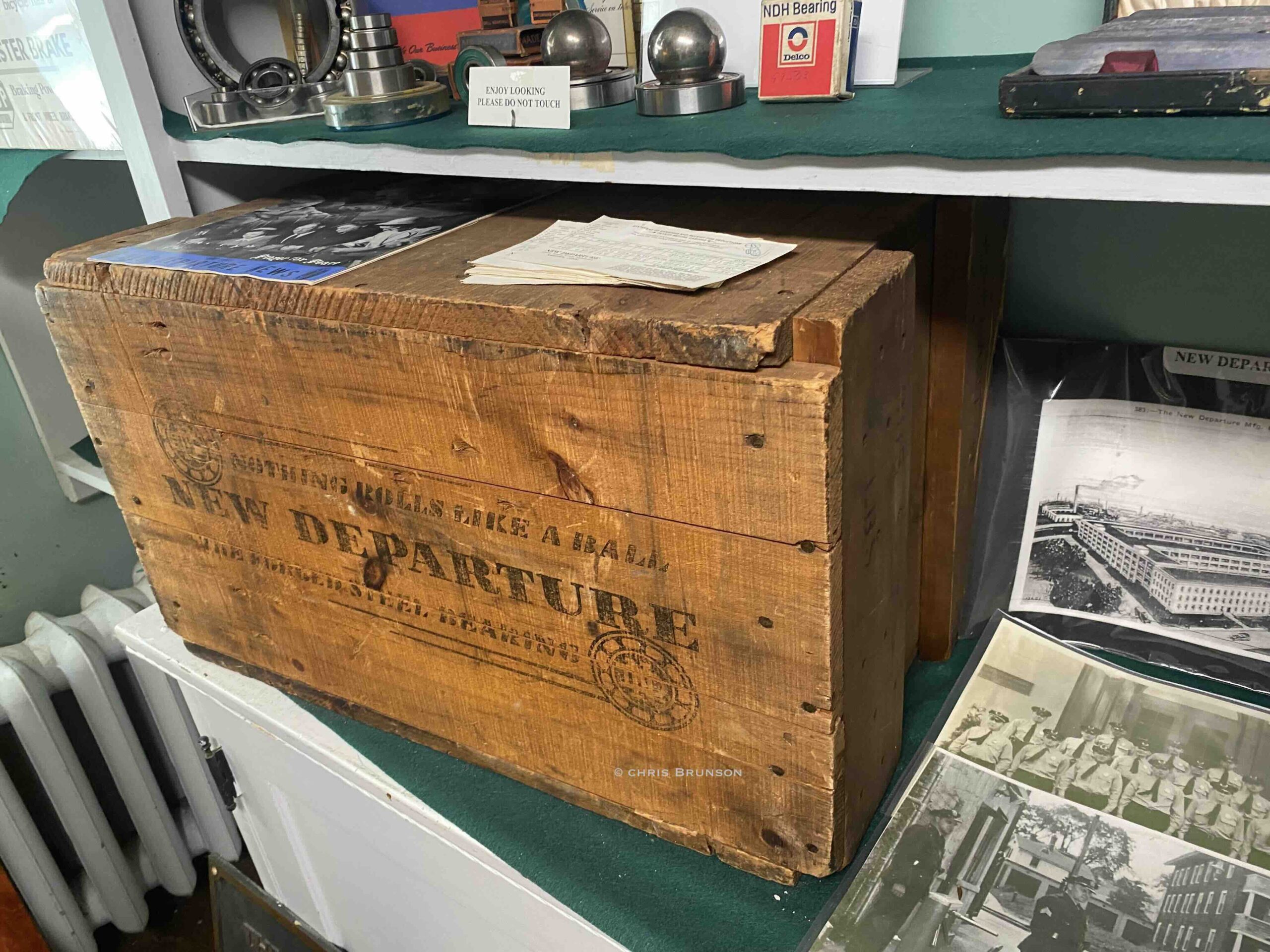
New Departure, important to Meriden and so–this collection at one of the Meriden Historical Society properties. From an interview and tour, story. Image links to a related story.
Thinking.
Editor’s note: This story has been updated.