
Words & Fragments: Quonset. Canoe. Skunk. -Maug, -Paug.
You should be writing. Yet words dribble away in meaningless texts. Scrolling, to find–what? Stop.
— Moo Dog Press (@moodogpress.com) July 20, 2025 at 2:57 PM
Go. Frittering a gift away? Write.
Their Kindred Earth (newly published book on left, a sleeper) “gathers images of Black Connecticut's historic sites by celebrated photographer William Earle Williams. A series of texts illuminate how these sites connect to the larger national and international narrative of Black American history.“
— Moo Dog Press (@moodogpress.com) July 20, 2025 at 9:08 AM
Hello.
Jerry Augustine and his book “Combat, Suffering and Renewed Passion in Life • Milton A. Toratti” with many photographs by the author. All proceeds from the sale of his go to support Greater Middletown Military Museum. Tku to Betty, his wife, for mentioning that. #localauthors #BookWalk
— Moo Dog Press (@moodogpress.com) July 19, 2025 at 1:02 PM
(Yes, see the word “book” is missing–that was written while in Old Wethersfield that day. Human.)
Time and stories. Ten years ahead; maybe 20. Writers peeling off from legacy media, starting their own ventures.
#GoogleZero is definitely a concern people are talking about. Platform dependence is a problem for MANY reasons. If you are in NYC in August, come out to #ProtocolsForPublishers where we will be discussing this and more —frontier technologists working together with newsrooms 💪
pfp.unternet.co
— Chad Kohalyk (@chadkoh.com) July 22, 2025 at 6:50 PM
Recent, past and present flow together. Words are clues. Connecticut.
“From the names of states, cities, and towns to the names of rivers, lakes, mountains, and deserts, the contributions of Native American languages are omnipresent, and too many to catalog here.
“For a sampling, the following are names of tribes that have been applied to places, including states (Illinois, Delaware, Massachusett, Iowa, Kansas, Alabama, Missouri), cities and towns (Miami, Montauk, Mobile, Biloxi, Cheyenne, Natchez, Wichita, Spokan, Walla Walla, Yuma), rivers and lakes (Erie, Huron, Missouri), and mountains and deserts (Apalachee, Teton, Mohave, Shasta).
“More place names come from other indigenous words. Connecticut, which names both a state and a river, comes from an Algonquian word meaning “land on the long tidal river,” and the state of Wyoming gets its name from a Delaware word meaning “land of vast plains.”
“While you are looking, you might as well also listen, linger and think about what you see.” – Jane Jacobs
Meriden. (Oh wishing for a solar manufacturer to find the former Miller complex and set up shop.)
A brook runs beside this site, under a hallway of a structure that leads to another complex of buildings. Flowing water is important to life and business.
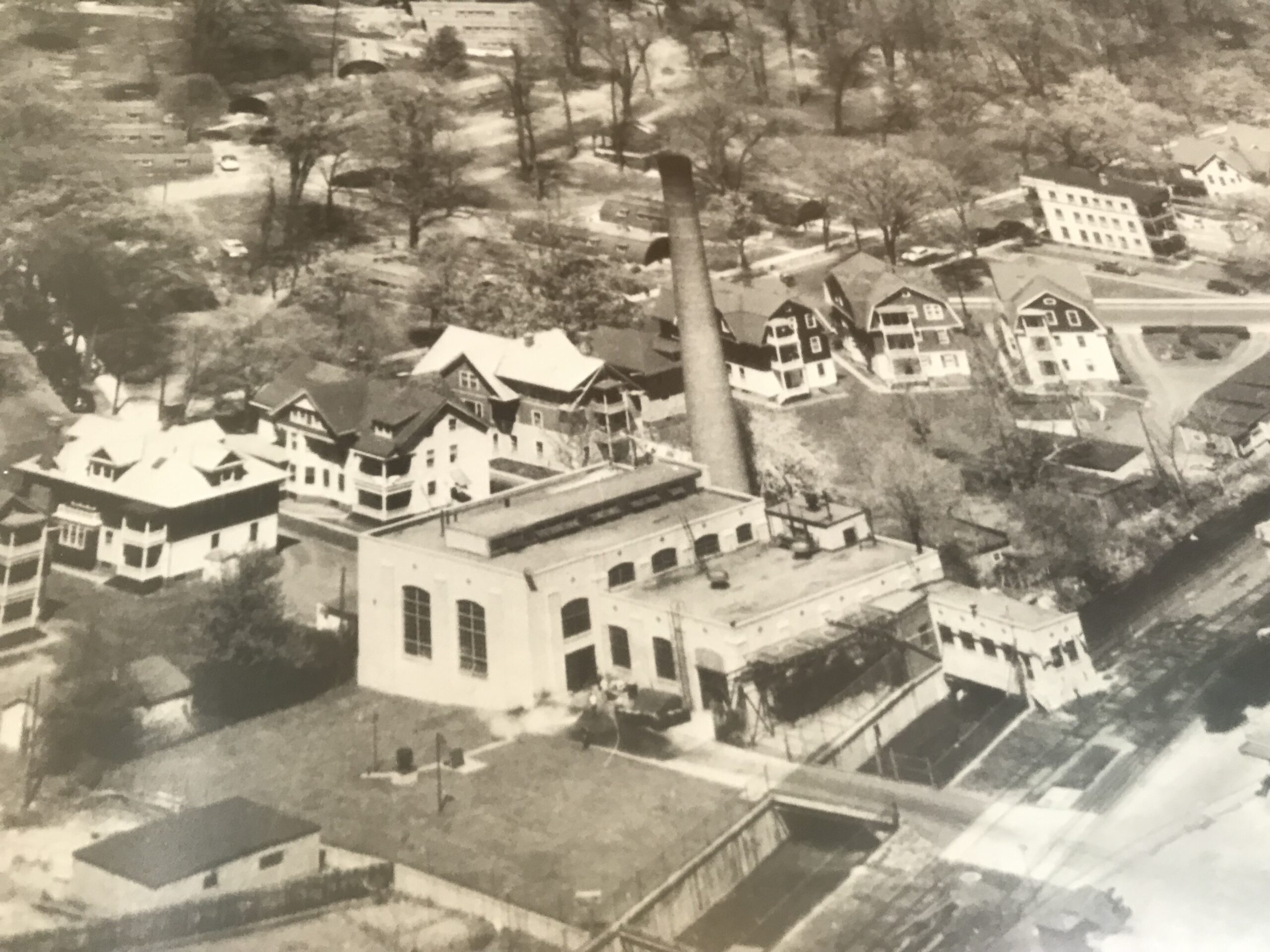
Walk around looking for one thing, discover something else. Aerial view detail of a structure behind 290 Pratt Street; note the Quonsets that appear in this image, City Park.
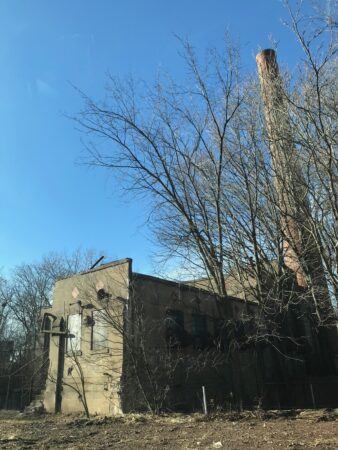
The snout of the building, seen in the aerial view detail. Imagining this spiffed up and humming with life as a community center, used bookstore, gathering place.
My late sister thought a brewery inside the main complex would be a natural fit for this place, in time. Look up at the beams, the details, she said. And with her words, my imagination filled in the scene.
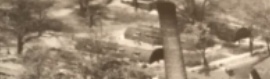
Quonsets in Meriden detail; use smokestack to orient location in larger image.
Quonset. Look up the origin of this word and, not surprised–“1942, from Quonset Point Naval Air Station, Rhode Island, where this type of structure was first built, in 1941. The place name is from a southern New England Algonquian language and perhaps means ‘small, long place,'” according to Online Etymology Dictionary.
From a bustling factory making vital components for machines to a quieter place now home to a variety of small business, entrepreneurs and yes, innovation. Offices in the front section; a hidden courtyard that await someone who sees its potential. Well-built homes stand as a border along Camp Street. The interstate hums with transportation above. Harbor Brook still flows, now into above ground through Meriden Green and beyond on its way to the Quinnipiac River, of which it is a tributary. Streams and rivers may be buried but if not engineered well, water will seek its own courses and not be ignored. Watersheds feed all layers of life. Mills and factories located near water that could be counted on to carry away wastes, dye, effluent once upon a time–and not so very long ago.
History is brutal, but should not be sanitized.
Meadows. Meriden has a “meadows” much like Haddam Meadows, Cromwell Meadows, Middletown meadows (where the mud volleyball is played)–it’s known as Meriden Green. Peel back the layers of time and note the recharge area as all streams ebb and flood. It’s their nature. Rivers do the same. Ignore the at your peril, water goes where it wants.
Read widely; not everything is online. A curated social media feed–editors, writers, scholars, authors, publishers; and unique voices. Art. Observant humans. Horses, dogs, yes. Aerospace, local business, manufacturing, reporters. People who see.
A book that may provide insight or a destination is Connecticut, An Inventory of Historic Engineering and Industrial Sites by Matthew Roth, Bruce Clouette, Victor Darnell.
Industrial sites have left a legacy of sorts in not only what they made, but the solvents and such used before effects were known. Brownfields, the term used now to describe the knowledge of how long all combined lasts coupled to land, water, air. For a list of current project applications that include Connecticut via the EPA, visit this link.
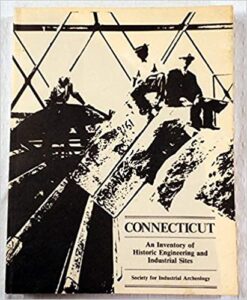
Connecticut, An Inventory of Historic Engineering and Industrial Sites. Author and project director, Matthew Roth; additional writing and research by Bruce Clouette and Victor Darnell.
Food along the way. A landmark local business, remembered. It’s there and as superb as ever. The bald eagle flying over at the Connecticut River, another gift.
Chicken cutlet parm, Wethersfield Pizza House. Then went to enjoy this massive delicious layered meal by the CT River.
And a bald eagle flew by.
— Moo Dog Press (@moodogpress.com) July 19, 2025 at 3:54 PM
Editor’s note: This story has been updated.