
Inspiration: John Mills & Alex Breanne Corporation + Venture Smith Day
I speak out against slavery
You could have done so much more if you only had—
[ELIZA AND COMPANY]
Time
[ELIZA]
And when my time is up, have I done enough?
[ELIZA]
Will they tell our story?
[COMPANY]
Will they tell your story? – Hamilton
John Mills is not wasting his time, energy, talents and skills.
Mills, a Connecticut-based genealogist, independent scholar, and founder of the nonprofit Alex Breanne Corporation–dedicated to “recovering and presenting the stories of enslaved African Americans”–has an impressive roster of accomplishments and he’s so young.
Key facts about Mills and his work:
The Alex Breanne Corporation: Named after his daughter, the nonprofit aims to “reinject” the stories of formerly enslaved people into history. The organization researches, presents, and helps memorialize lesser-known figures from the Black experience in America.
Notable projects:
Prince Mortimer: Mills has extensively researched Prince Mortimer, an enslaved man in 18th and 19th-century Connecticut who was imprisoned at the notorious New-Gate Prison. The Alex Breanne Corporation has advocated for memorials and honorary street names for Mortimer.
Mary and Thaddeus Newton: His research helped restore the headstones of Mary and Thaddeus Newton, a free Black woman and an enslaved man who were married in North Carolina before moving to New Haven, Connecticut.
Isaac J. Hill: Mills also helped a family trace their lineage to Civil War soldier Isaac J. Hill, whose memorial headstone was installed in a cemetery in Woodbury, New Jersey.
Speaking engagements and media: Mills is a frequent speaker at museums and historical societies.
Other affiliations: He has served on the Connecticut Freedom Trail and the Webb Deane Stevens Museum Council.
Genealogical focus: As a descendant of enslaved people, Mills uses his passion for genealogy to help African Americans trace their ancestry, which often involves using fragmentary historical records.
(Hoping for a full segment of Finding Your Roots–featuring John Mills. Henry Louis Gates Jr., historian, literary critic, filmmaker, author, Harvard University Professor, is the creator and host of the groundbreaking PBS series Finding Your Roots.)
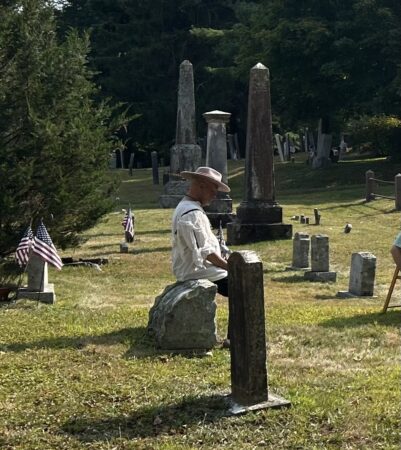
In attendance.
The 30th Annual Venture Smith Day Connecticut Freedom Trail Celebration will be held on Saturday, Sept. 12, 2026 1 to 4 p.m., at the First Church Cemetery, 499 Town Street (Route 151) in East Haddam, where Smith (1729-1805) is buried. Please bring a chair or blanket to sit on and umbrella for shade if sunny. If raining the event will be held inside the First Church of Christ Congregational. Exhibits and refreshments will be served following the event in the Church’s Fellowship Hall.
The following video by the late William Hosley tells the story of three cultures intertwined and includes the Venture Smith stone, details of his life:
Are you going?
Venture Smith Day (2026) speakers:
Dr. Matthew Warshauer, Professor of History at Central Connecticut State University, and a nationally recognized scholar of American political and constitutional history, will talk about how “The American Revolution was Fueled by Sugar: Connecticut as the Provisions State.” Connecticut served an oversized role in supplying George Washington’s army during the American Revolution. Without that support, both in terms of actual supplies and logistics, it is questionable if the fledgling rebellion could have been sustained in its first year.
Dr. David J. Naumec, American military historian, battlefield archaeologist, and museum professional specializing in early American social history, conflict archaeology, and the military service of Indigenous and African Americans in New England will talk about “Connecticut’s Indigenous Troops: Army, Navy, & Marines 1775-1783.”
Dr. John Wood Sweet is an award-winning historian, author, and Professor of History at the University of North Carolina at Chapel Hill. He will present “Venture Smith and the American Revolution.” A specialist in early American history, he focuses on the social and cultural histories of race, slavery, gender, and everyday life in colonial and Revolutionary America.
Gary Red Oak O’Neil, Wangunk Elder and Historian, teacher and potter, will talk about “Employment and How It Affected the Smith and Wormsley families in 1940.” Red Oak is also a descendant of Venture Smith through marriage. He works to restore the historical narrative of the Wangunk, ensuring their heritage is integrated into local civic initiatives, such as the riverfront revitalization projects in Middletown. He has taught at Wesleyan Potters since 1968.
Dr. Karl P. Stofko, East Haddam’s Municipal Historian and Venture Smith family genealogist since the 1970s, will talk about “Cuff Smith, American Revolutionary Soldier.” Dr. Stofko received the 2022 Award of Merit for Individual Achievement from the Connecticut League of History Organizations (CLHO). He is co-author of “A Brief History of East Haddam, Connecticut.”
“The Sisters In Stitches Joined By The Cloth” of eastern Massachusetts will return with their magnificent African-American quilts. Venture Smith’s family genealogy and family photos and artifacts from their trip to Ghana will be on display. Also, a Town of East Haddam proclamation will be presented. A wreath-laying ceremony by the descendants of Venture Smith and the annual Venture family reunion photograph will take place in the cemetery by Venture Smith’s grave.

The Venture Smith Stone “442 pounds” (!), still image from the Stanton Davis House; video by the late William Hosley, 1:39 in video. Linked to source.
Recent related story linked here.
A related story from Norwichtown linked here.
From 2012, well worth reading for context and sweep of connections:
Peter Freeman and Whacket Freeman: Towards an Archaeology of 18th Century Black Homesteads
Lucianne Lavin, Ph.D.
Institute for American Indian Studies (Editor’s note: Lavin is Director Emerita of Research and Collections at the Institute for American Indian Studies, a museum, research and educational center in Washington, CT, a position she held for 18 years. She is a founding member of the Native American Heritage Advisory Council (a government agency whose appointed members advise the Office of State Archaeology and State Historic Preservation Office on Indigenous sacred sites), and retired Editor of the journal of the Archaeological Society of Connecticut, a position she held for 30 years. Dr. Lavin is an anthropologist & archaeologist with more than 50 years of research and field experience in Northeastern archaeology and anthropology, including teaching, museum exhibits and curatorial work, cultural resource management, editorial work, and public relations. For more, see https://independent.academia.edu/LucianneLavin.)
Paper presented at Venture Smith Day, First Church of Christ, Congregational in East Haddam, CT September 15, 2012.
Introduction
Many of you in the audience are probably thinking: Who is Peter? Who is Whacket? And what o they have to do with Venture Smith Day? Those are good questions.
Peter and Whacket have a lot to do with Venture Smith. Firstly, they were contemporaries of Venture. Their historical and archaeological stories give us a glimpse into the local black community, of which Venture was a part. Secondly, they provide insight into Venture’s character and how he saw himself – his role – within East Haddam’s black community.
And that is what my talk today will explore.
Our archaeological study of the Peter and Whacket home lots was part of a much larger survey of the Connecticut Yankee Atomic Power Company property Lavin and Banks 2005, 2007). This is a 582 acre plus parcel at the southern end of the Haddam Neck peninsula – which belongs to the Town of Haddam. As most of you know, Connecticut Yankee recently completed decommissioning this plant. As part of that process CT Yankee was required to pay for a comprehensive archaeological survey of the entire property – to identify significant archaeology sites and assess their potential for eligibility to the National Register of Historic Places – and to develop management alternatives for these sites.
My firm, American Cultural Specialists, was chosen to perform the survey. We conducted a seven year study of the property. We identified 30 Native American, Euro-American, and African-American sites across the landscape. Fifteen of those sites are considered historically significant and eligible for the National Register of Historic Places. The Venture Smith Homestead and the two other African-American sites, representing the homesteads of Whacket Freeman and Peter Freeman, are included in those 15 significant sites.
In 1778 Venture Smith sold a 12-acre strip of his farmland to two free black men from East Haddam, Peter Freeman and Whacket Freeman. Who were Peter and Whacket? Historical documentation for them is scanty. But our favorite town historian, Dr. Karl Stofko ferreted out (Karl Stofko is the town historian of East Haddam, and an expert on the history of its internationally famous African American citizen, Venture Smith, as well as on the town’s African American history in general) those records, and the following historical description of their lives is a result of Karl’s research.
Perhaps we should consider Karl my co-author on this paper.
The Historical Evidence:
Whacket Freeman
Whacket Freeman was born a slave around 1746. His owner was Daniel Brainerd Esquire, a wealthy East Haddamite who owned a wharf and warehouse on the Connecticut River, at the Upper Landing. After Brainerd’s death in 1777, Whacket was given his freedom. Sometime after, Whacket purchases Base, the female slave of Brainerd’s widow, and marries her at the First Church of Christ, Congregational in May 1778. Two months later, he and Peter purchase a 12 acre strip of land from Venture Smith for 66 pounds. The strip ran from Salmon River Cove northward into the wooded uplands, giving the men access to both riverine and woodland resources. Most of the rocky upland was on poor soils, suggesting it was important for its wood and stone resources rather than farmland. The Salmon Cove end of the strip was within an area traditionally known as “The Sand Bank”, an important fishing shore. Peter signed the deed with an “X”, and Whacket did the same on a 1780 deed, showing that both men were illiterate.
Little less than one year later, Whacket and Peter split the property, Whacket taking the south portion and Peter the northern part. They were apparently living on the property, as both are listed as Haddam residents in the deed. A later deed described “appurtenances”, which indicates buildings. One year later, in March 1780, Whacket mortgaged his land to Amos White of East Haddam for a whopping 500 pounds. Amos White was a white entrepreneur who ran a tavern and cooper’s shop while managing Humphrey Lyon’s mercantile store. He was a business associate of Venture Smith. They engaged in a number of land transactions in the 1780s and
early 1790s. Whacket was unable to pay the mortgage, White foreclosed and in March 1788 White sold the parcel back to Venture Smith for 30 pounds. By 1790 Whacket and his wife were living in a small house on Amos White’s property at the East Haddam Upper Landing. In 1792, Whacket died at 46 years of age, leaving a widow and no issue (Karl Stofko, unpublished research records dated September 2, 2004).
Peter Freeman
Peter was born a slave in 1756 and baptized at the First Church of Christ, Congregational in East Haddam. He was given his freedom sometime before 1778. In May of that year he married Peg, also a free black, at First Church. Soon after they moved to the 12 acre strip on Haddam Neck.
Peg apparently died between 1780 and 1781, as Peter married a white woman named Sarah Archer in October of 1781 in East Haddam. In December 1782, Peter sold his Haddam Neck property back to Venture Smith for 20 pounds. He lived the remaining years of his life in East Haddam with his wife and 7 children, dying in 1805 at 48 years of age (Karl Stofko, unpublished research records dated Sept. 2, 2004).
The Archaeological Evidence
We believe that we located both Whacket and Peter’s home lots, not far south of the original 10 acre strip of land purchased by Venture Smith in 1775. One home site was on an upland ridgeline near a small spring, just off the colonial wood road that connected the homes of all the residents of the small community living on southern Haddam Neck. The site yielded only 143 historic artifacts. In comparison, Venture Smith’s home site contained over 149,000 historic artifacts, three houses with stone-lined cellar holes, and 8 or 9 other outbuildings as well as at least one barn complex in the field above his compound.
At this site, there were no stone foundations or stone piers to mark the house and no evidence of an outbuilding, just a small concentration of 18th century nails and domestic debris, which included ceramic and window glass fragments. They suggest a small, windowed, ephemeral structure had once stood there, perhaps about 10 feet by 15 feet in size or smaller. The great majority of the ceramics were inexpensive redware. There was one kaolin pipe stem fragment – unlike Venture Smith, the owner smoked. The sparse artifacts and light domestic footprint correspond with a short occupation of the property.
The second home site was located to the south, or east, of the first house – depending on where the deed claims south to be. The house lot was near a spring on a small terrace overlooking Salmon River Cove. Below it was a small point of land that held the stone foundation of a small dock or wharf. The point is still a favorite fishing spot for 21st century fishermen. The home lot contained twice as many artifacts as the inland home lot, but they were similar in nature – 18th century iron nails, kaolin pipe fragments, and redware tableware. It also contained stacked stonework that suggested the foundation or pier of a house.
We originally identified the inland home lot as Whacket’s property, and the home lot overlooking Salmon Cove as Peter’s. This identification was based on the archival work of historical archaeologist Robert Gradie, who was the historical consultant during our CT Yankee archaeological surveys (Gradie 2007). Gradie had reported that Peter remained nine years longer Smith in 1780, and that Peter had remained until 1789, when he sold his portion back to Venture.
However, Karl’s research shows that Peter sold his property in 1782, not 1789. Karl also reported that the 1780 deed between Whacket and White was a mortgage, and that Whacket may have continued to live on the property until 1788 – 6 years longer than Peter, when Amos White foreclosed and sold the property back to Venture.
If this is the case, then the relatively sparse inland house lot could be Peter’s and the more substantial house with footings on Salmon Cove could be Whacket’s. That whopping $500 mortgage makes more sense with this scenario. Whacket may have intended to try his hand at river trading, like his successful contemporary Venture Smith, with the $500 going for boats, equipment, and an expansive wharf at the point. I speculate that Venture helped Whacket obtain the mortgage from Amos White, a white man he knew and who was a trusted business associate.
Summary: Continued at this link or read original source, link.
Editor’s note: This story has been updated.