
For Perspective: Geological Time, Strickland Quarry, CT Rockhounding
Vai Pure. (Keep going.)
Geology in Connecticut and New England? Fascinating, a library of earth processes and time. More to the point, endlessly calling for outings, walks. And deep time to remind all that humanity as we know it is fleeting, a blip in the long history of the planet.
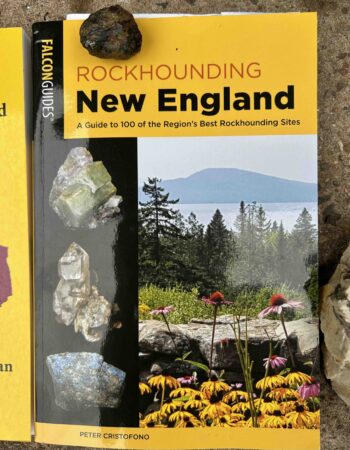
Rockhounding New England: A Guide to 100 of the Region’s Best Rockhounding Sites (Rockhounding Series) by Peter Cristofono (Falcon Guides). Image links to official site for more about the series.
A image-rich 330-page book to savor by Peter Cristofono (even if a reader will not ever get to these places in person as many are off limits unless on an authorized field trip): “Rockhounding New England: A Guide to 100 of the Region’s Best Rockhounding Sites” (Falcon Guides 2020). Each page is packed with details to enjoy. Propped open for lunch, the book contains passages so good that words are read aloud. A bookmark placed to share on the next field trip drive, journey. Thank you, thank you.
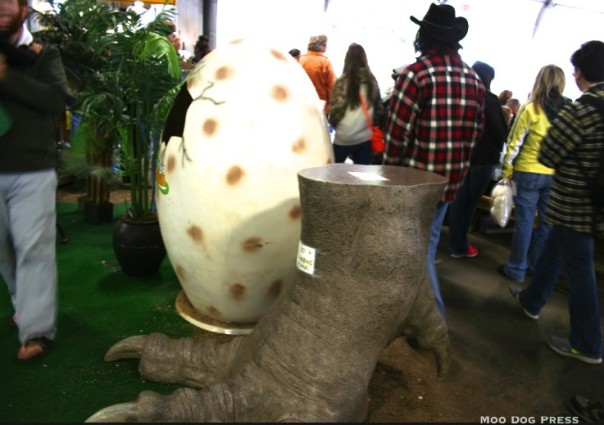
A dinosaur foot and egg replica – part of the fun on the Connecticut Dinosaur Trail. Geology in the CT River Valley is full of interesting sites to visit.
Oh man. This book is a wonder. Heavy stock, color images, well-designed pages.
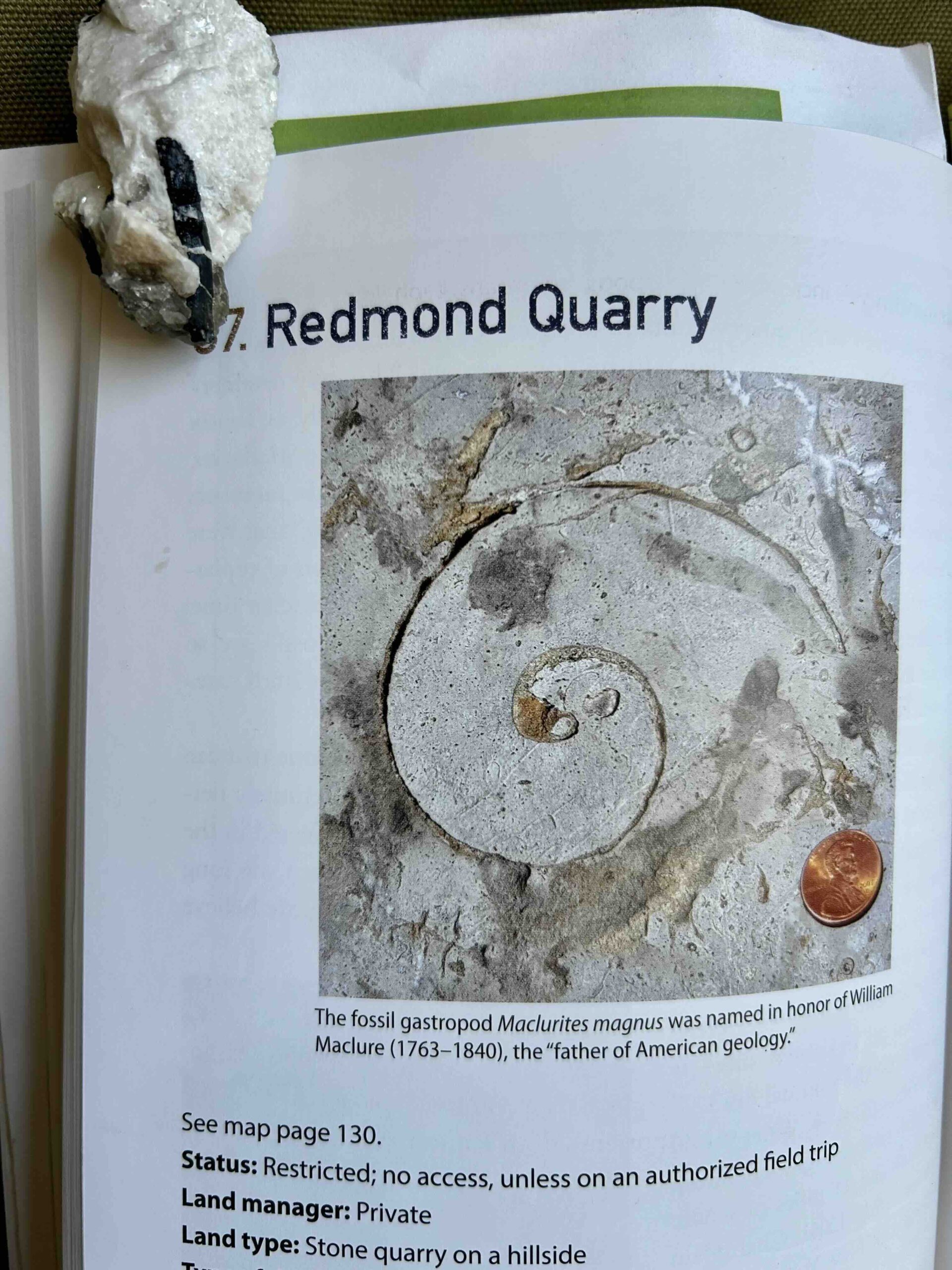
Page detail of the beauty in the author’s images inside “Rockhounding New England: A Guide to 100 of the Region’s Best Rockhounding Sites (Rockhounding Series) by Peter Cristofono (Falcon Guides)”–and his writing shines too.
Tales of deep time in stone. Natural forces, continents rent asunder. Volcanoes. Lava. Mud flats. Glaciers, outwash plains.
Terminology, delicious words–an ocean named Iapetus. Pegmatite. Galena. Twinned crystals. Clasts. Shale. Gemmy.
Along with sites, specifics, color images, a reader can pore over the descriptive special attractions as well as places of interest in the area nearby. Social history, connections to human history. Notables.
Listings of resources include mineral clubs — because many of these places must have a leader and be approved to access.
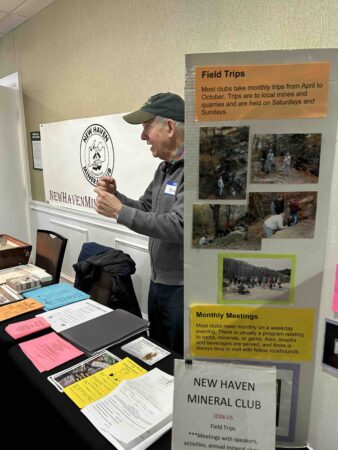
At a gem and mineral show in 2025.
Appendix B is Rock, Mineral, and Fossil Displays. (Be still my heart.) Appendix C is Shops by state. Appendix D is Additional Resources which includes filed trip guide businesses (fee-based) and education events with field trips such as the New England Mineral Conference. The bibliography alone is a trove of more reading.
Accommodations if staying over? Also listed. Directions, maps. elevation, vehicle (in many case, 4WD). Managers, contact. And. Best season.
Because the rocks are also rattlesnake and copperhead habitat with nooks and crannies of old quarries in woodsy places. This is their home after all. Also, footing can be slippery; wear footwear with ankle support.
“There is nothing like looking, if you want to find something. You certainly usually find something, if you look, but it is not always quite the something you were after.” – J.R.R. Tolkien
Isinglass. Schorl. Feldspar. Basalt.
Hills and valleys. Basalt and clay. Rugged rock and landforms taken for granted until going away and roaming the country. One place is not the same as others for access to delicious water, rich soils. Clear cold springs. Fossil trackways and volcanic ribbons of rock. Home again.
Mica. Books of mica.
Glittering bits amid shards of chalky feldspar can be seen sprinkled among outcroppings at the well-groomed Quarry Ridge Golf Course in Portland, Connecticut. Earth and rolling hills blanket what was once known as Strickland Quarry, a fabled destination years ago.
Today, collections of the rich mineral resources once unearthed at the Strickland quarry may be seen at places such as Wesleyan University’s Joe Webb Peoples Museum online.
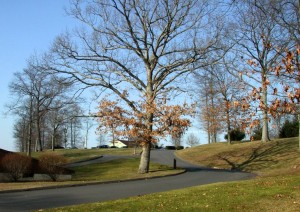
Up the hill the entrance to Quarry Ridge, the entry was once a path to Strickland’s Quarry.
Memories of years long past are of climbing a steep path following my family up to the towering heaps that were mine tailings. It was quite a hike. As a child to find treasures with names such as tourmaline, schist, feldspar, smoky quartz, garnets and crystals created joy that could barely be contained. The olive-green battered canvas rucksack and hammers with pointed ends for digging made the excursion serious stuff. Small chisels split murky-looking rock to reveal fresh surfaces and bright minerals within. Later, we’d perch on a hill and overlook the valley below to feast on ham sandwiches, a pickle, chips – all packed by my mother.
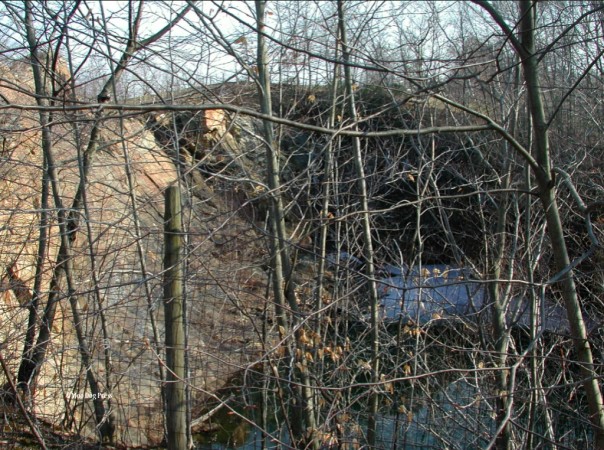
Fenced off for good reason (danger!), there is still a glimpse of the mine workings.
And more recent interviews, discoveries.
“If someone were to dig a trench eight feet deep almost anywhere in The Flats, the stratum of glacial deposit would be obvious…sort of like a slice of lasagna.”
Simon Donato
📖 The Flats: Some Memories of Woodbridge’s West River Valley
#SundaySentence
— Moo Dog Press (@moodogpress.com) March 23, 2025 at 10:39 AM
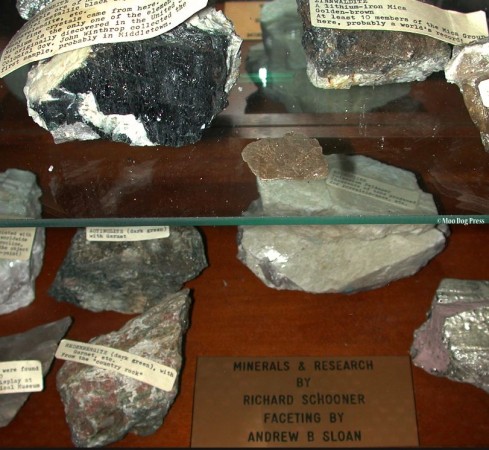
A close-up sample of diverse minerals once found on site.
Here is a page from the past (the mine, obviously, is not operating any longer): “Undoubtedly the best pegmatite locality in Connecticut, from the standpoint of the mineralogist, is Strickland’s quarry in Portland. . . . interesting minerals are found only in the largest or main vein. The pegmatite is composed almost entirely of buff microcline and smoky quartz. … Muscovite, which is not abundant, occurs in plates up to 15 centimeters in diameter, nearly all of which show the twinning structure known as feathering,” from an article in The American Mineralogist by Earl V. Shannon, U. S. National Museum.
I have no idea what some of that terminology means, but do recall watching as my father trimmed large sheets of mica for replacing the “glass” in our downstairs metal wood stove, which had a double row of small windows. The transparent mineral looks like flexible glass and I was fascinated that a rock could be peeled and placed to withstand the fierce heat generated and contained in this device.
Years later I learned that the word “isinglass” – as in “The wheels are yellow, the upholstery’s brown, The dashboard’s genuine leather, with isinglass curtains y’ can roll right down, in case there’s change in the weather” sung in The Surrey with the Fringe on Top featured in the movie Oklahoma was actually my old friend, mica.
“The Strickland Quarry is debatably the most famous locality in Connecticut. The amount of minerals it produced was impressive, as was the quality of specimens. Strickland lies on the eastern side of Collins Hill in Portland, Connecticut.
“History: The Strickland quarry was operated for high-grade feldspar and from 1904 to 1960s. There is some speculation of the date the operation was started. It is possible that operations began in the 1840’s. The owner from 1904 to 1945 was Mr. F. E. Strickland. He collected many interesting specimans from his quarry, and these can be found in some old collections. The nearby Schoonmaker/Cramer Mine, an underground operation, was not connected to the Strickland Quarry. However, Strickland did have some underground workings. The larger northern dumps belonged to the Schoonmaker mine.
“The Strickland Quarry was leased to Eureka Flint & Spar Co., Eureka Mining & Operating Co., or Eureka Mica & Mining Co. The operators after Strickland were George Wilkes, and then William Wilkes. As well as feldspar and mica production, Strickland is noted for beryl, gem, and quartz production. Operations ended in the 1960s.
“While the quarry was owned by Strickland, collectors could work in the dumps. They were allowed to keep anything that wasn’t particularly gemmy. These were given to Strickland, and would eventualy be sold. Specimans found while working the quarry were sometimes sold to visitors.”
— from History and Mineralology of the Strickland Quarry (2016) by Rowan Lytle, linked here (the images of specimens, simply amazing).
Afternoon walk, Deep River.
— Moo Dog Press (@moodogpress.com) November 27, 2024 at 3:46 PM
Nearly every child notices and picks up small treasures–pebbles, rocks, leaves. (My sister liked earthworms quite a bit; our mother would later find them floating in the washing machine. She learned to always check those pockets first.) Some humans never grow out of this phase. As one of the latter, to connect with a person with similar interests later in life is also a marvel. Out we go, wandering, wondering, collecting bits of flotsam and jetsam. Nostril rock. A shiny mosaic-like mica shard. A jagged clear-crystal (not glass) triangular bit that sits on my desktop–a touchstone for recalling that day. Cave. Icicles like fangs on a sheer cliff in winter. A canine companion that kick-kicks and revels in the laughter she provokes. Memories of visits and time shared–the best kind of life collection.
Editor’s note: Looking for the story on Venture Smith Day? It is linked here.