
Mamoosan’s Annual Trek To ‘Meadows Field’ His Tree + Ancestors
Some ideas whisper and will not be denied. Tap, tap. Listen.
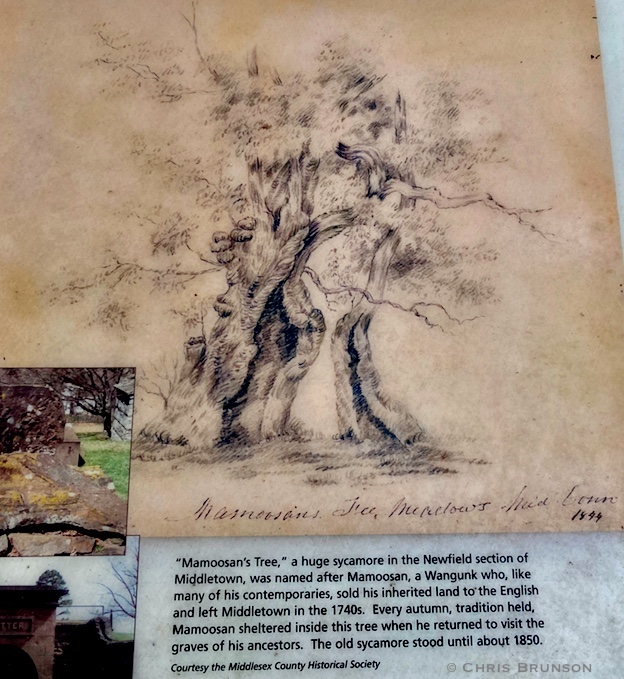
Mamoosan’s tree. And what appears to be the words “Meadows Field Conn.?” Enhanced and cropped image to view. Spelling differs regarding his name, depending on source.
A tree and memory evoked by new buildings and that old barn gone. Newfield Street, Cromwell to Middletown, Connecticut.
“This huge sycamore tree served as shelter for Mamoosan (“Son of the Moose”) during the mid-1700s. As the Wangunks’ lands and opportunities here dwindled, many of them, including Mamoosan, moved to northern New York. They left behind the graves of their ancestors in a burying ground just west of what is now Newfield Street, nearly to Cromwell. Mamoosan journeyed back to Middletown every autumn, beginning about 1750, to visit his ancestors’ graves. The great sycamore stood nearby, and at night Mamoosan slept inside its hollow trunk. In 1844, a Middletown woman named Frances Oliver sketched the tree – then 19 feet around – a few years before it came down.” –Middlesex County Historical Society
Wanting to know more propels life forward. An itch that is curiosity.
From Historic Towns of the Connecticut River Valley: “The last of the Tribe of Mattabesett was Mamoosun (sic), a high-spirited old man, whose faithfulness to his tribe and its traditions, was inspiring. Where Mamoosun lived is not positively known, but that he made annual visits to Middletown each autumn, for the purpose of paying respect to the memory and the greatness of his tribe, is a matter of history. He spent whole days in the Indian burial ground, near Newfield, mourning over the past glory of the dead who were buried there.
“On these annual pilgrimages the old Indian seemed to live more in the spirit than in the flesh, and there can be no doubt that his mind was in an exalted state as it dwelt on the past. During this period he shunned mankind and spent his nights in the hollow of a gigantic sycamore, of great age, that was known for many generations as Mamoosun’s tree.
Mamoosun’s pilgrimages began before, and continued for several years after; 1720.
Layers of time. Ghosts of a sort. Tell my story. Remember me.
(Frances Oliver, thank you for such artistry for capturing this magnificent tree with your work on paper. And to Middlesex County Historical Society and Indian Hill Cemetery for showcasing this story. Placing a sign for a walker to find, read.)
Nineteen feet around, that tree was.
“The white settlers of Middletown honored and respected the dignified, sad old man who alone of all his tribe still lived. A Mr. Gilbert, who owned the farm upon which the Indian burial ground was situated, was most friendly and hospitable to Mamoosun who, after his days of mourning and religious duties were finished, would go to Mr. Gilbert’s home as his guest.
“Mamoosun dreaded above all things that the graves of his dead should be disturbed by the plow and harrow. Mr. Gilbert promised him, that so long as he lived the field should not be cultivated and the promise was faithfully kept for several years after the visits of the old Indian had ceased.”
Did the people who came afterwards honor this promise?
Thinking of the rivers in and around Cromwell, Middletown. The Meadows. A burial ground would be on high ground; knowing the cycles of the great river that is Connecticut and flooding that is part of its character. High ground. Is it sketched in on any map over time? Mr. Gilbert, where is your farm on land maps?
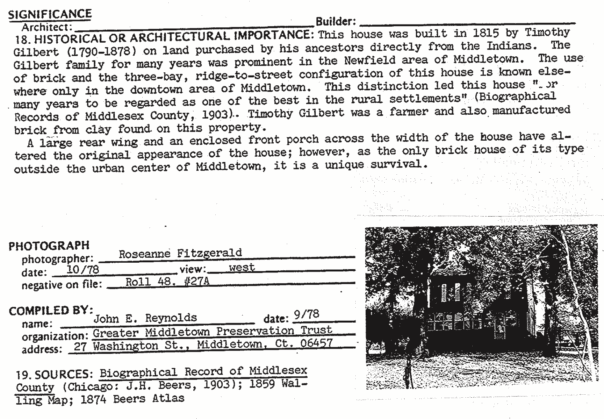
A detail of a Gilbert on Newfield Street. Linked to source.
“This house was built in 1815 by Timothy Gilbert (1790-1878) on land purchased by his ancestors directly from the Indians. The Gilbert family for many years was prominent in the Newfield area of Middletown.”
Meanwhile, another chapter of humanity.
“Everybody’s grandmother” — the native name given to Gladys Tantaquidgeon when she was a child by Fidelia Fielding, who was the preserver of Mohegan language, diaries; Fielding’s was Martha Uncas (1761-1859).
“A child who stood out.”
The Common Toad podcast with Melissa Tantaquidgeon Zobel, an award-winning author, screenwriter, Medicine Woman and tribal historian for the Mohegan tribe of Uncasville in Connecticut.
“I had the privilege of speaking to Melissa a few weeks ago. We discussed the history of the Mohegan people, the extraordinary story of Melissa’s great Aunt Gladys (the preceding Medicine Woman in the tribe and a woman who drew breath in three different centuries), perspectives on history, and writing.”
0:32 – Introduction
7:10 – Uncas and the origin of the Mohegans
15:17 – An introduction to an extraordinary Mohegan woman, Gladys Tantaquidgeon
28:44 – Gladys travels the country collecting native stories
34:58 – Gladys returns home, becomes a matriarch for her tribe, and helps found the country’s first Indian-run museum
42:01 – The world Melissa grew up in
45: 38 – The Little People: “If you believe in these things, then you can see through that veil into this ancient world”
49:32 – The curious mix of native spirituality and Christianity
58:36 – Melissa’s relationship to Gladys
1:02:42 – Melissa as a writer
1:07:54 – What is the proper way to integrate disparate histories?
1:19:34 – Hopes and prospects
The landscape before immigrants landed here must have been astounding. The beauty is breathtaking. Chauncey Peak allows a glimpse. Eric Sloane was here.
Ancient basalt mountains, clouds, sky. From Chauncey Peak, a beloved valley revealed.
(*With canine soundtrack. It’s a hike.) #Foliage
— Moo Dog Press (@moodogpress.com) October 23, 2025 at 4:33 PM
Other notable trees have been found and photographed. Connecticut is fortunate indeed to have such living treasures – and an ongoing project that documents and tracks trees in the state, called the Connecticut Notable Trees Project.
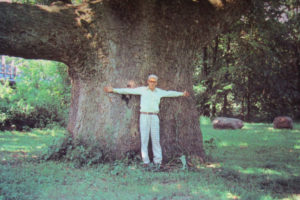
This photo graces the cover of the book about Connecticut’s Notable Trees book – man with arms outstretched in front of the Pinchot sycamore image is linked to the site of the trees project.
“We all share a concern for preserving this cultural landscape, the things that give our state its unique character. Trees are symbolic of our relationship with nature, a touchstone to the past and future.
“Established in 1985, the Notable Trees Project collects and distributes information about Connecticut’s largest and most historic trees, both native and introduced. By educating our fellow citizens about the importance of our state’s natural heritage we work to preserve it. It is a volunteer enterprise sponsored by the Connecticut Botanical Society, The Connecticut College Arboretum, and the Connecticut Urban Forest Council. A book by Glenn Dreyer, “Connecticut’s Notable Trees,” was published by the Connecticut Botanical Society and the Covered Bridge Press in 1989, 1990 and 1998. The later editions were the same as the original, except that they were perfect bound and included updated Champion Tree Lists. Most libraries in the state have copies of the book, which is currently out of print. “A computer database is maintained at the Connecticut College Arboretum that includes records of 4,048 individual trees in the state. Information for each tree includes size, location, ownership, and condition. The champion tree lists are derived from this database. Exact locations of the trees are not always given because we do not always have permission from owners of trees on private property to publish their locations. In the future, we hope to develop lists that will include locations of trees growing on land open to the public.”
Editor’s note: A portion of this originally appeared in April 2017; revised in 2023. This story has been updated.
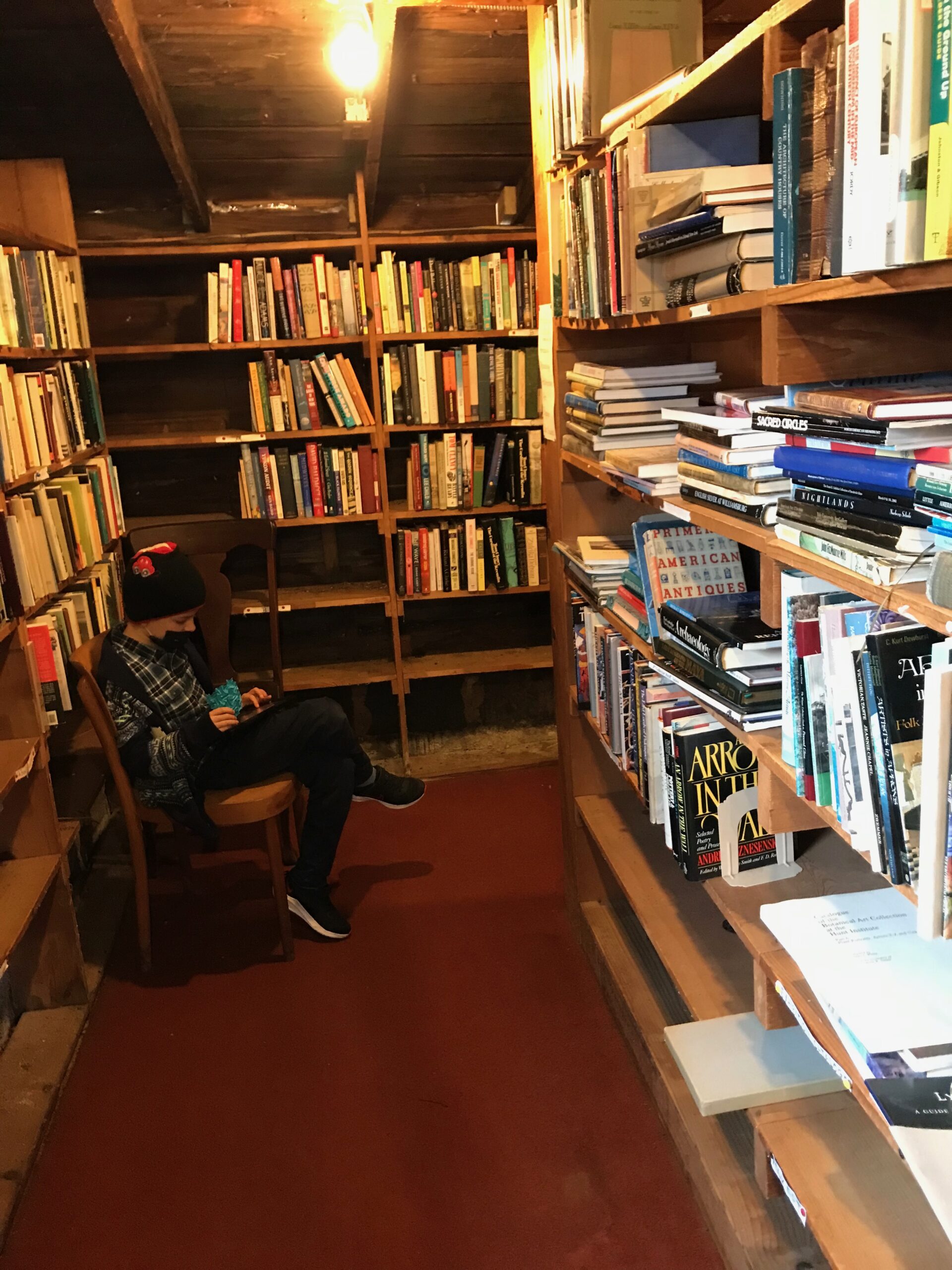
Close to heaven, Whitlock’s is. Image from a previous visit.