
Highland Country Club. Eric Sloane. International Silver Company.
You might see more value in his work if you knew that Sloane is the same artist who was commissioned to do a six-story wall mural for the Smithsonian Institution (SI) National Air and Space Museum, Washington, D.C. – to represent the “freedom and environment of flight” – a cloudscape with a lone plane as a visual tribute to aviation history and human pioneers. (For some eye-popping statistics for visitors – you’ll have to ask about the mural if it’s currently on view – here’s the link to the SI newsdesk reports for so far in 2017 – National Air and Space Museum alone – 1.2 million.)
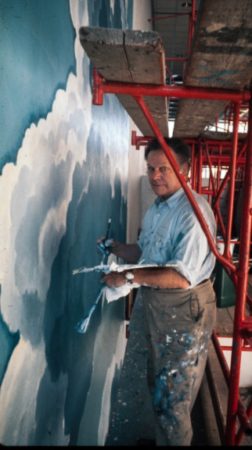
The artist at work – Smithsonian National Air And Space Museum image linked to the official site.
Resilient. Adaptable. Visionary. Author. Artist. Curiosity harnessed. Restless and opinionated, he had a home in Connecticut, another in New Mexico. Appreciative of the ever-changing science of weather, cloudscapes. Sloane could reverse engineer a covered bridge and “see” inside structures such as barns to reveal the pure function behind the forms.
His tribute to America’s spacious skies summed up, thus: “Sloane captured the essence and variety of weather above the panoramic landscape of the American Southwest. It is Sloane’s largest and most well-known cloud painting.” – Smithsonian Institute
Or how about this – Amelia Earhart bought one of Sloane’s early paintings of “just sky” – a cloudscape displayed at Roosevelt Field – this was before he was a well-known artist. The price was “exorbitant” according to Sloane, who combined his life stories with aviation, weather, sky, travels. Apparently Earhart recognized “real” when she saw it.
And how about the home of some guy named Alexander Hamilton? Decades before anyone cared, Sloane (who had grown up in the neighborhood and had gone back for a visit), saw the roof of The Grange – neglected, deteriorating – scrunched in between other buildings.
So he went to ask questions, find out what this place was – and wrote a book to illustrate why people should care about the building and its importance to the United States of America. Because of his efforts and the actions sparked in others, fundraising happened, awareness was raised. Sloane is and was excellent at providing context for objects, and this was a big goal.
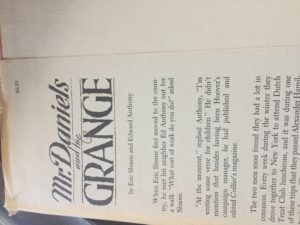
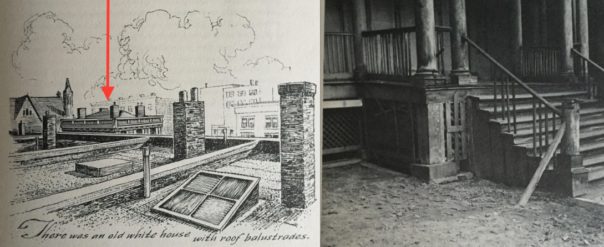
The red arrow at left points to the view Sloane saw of a building that made him curious enough to walk over and check it out. The structure was the former home of Alexander Hamilton. From the book, Mr. Daniels and The Grange.
So. Hamilton’s beloved home was not lost, but saved. The Grange is now part of the National Park System – officially called the Hamilton Grange National Memorial. It stands.
Story continues here. More context for Chauncey Peak and Sloane’s painting of it. Sloane wrote dozens of books about bridges, barns, ideas, innovations he observed in structures.
And from another side (quarry), view from the road.
— Moo Dog Press (@moodogpress.com) March 21, 2025 at 3:55 PM
Chauncey Peak is in Meriden, Connecticut, USA; a fun hike with some rock scrambles (use caution in winter). Choose the straight up trail for a memorable time (you may have to boost your dogs up in one part near the top). Not for the faint-hearted. But oh, the joy. Or choose to hike the switchback trail–it is still challenging but more accessible to most. Wear ankle-protecting boots. In warm weather, be alert for snakes–this is near perfect habitat and several species live here. Keep your dog leashed to avoid encounters–canines “see” what you may miss.
The Eric Sloane Museum in located in Kent, Conn., where the boulder and his epitaph “God Knows I Tried” are on view outside (call ahead for hours; the grounds are open for walks year-round but the museum is seasonal. Sloane’s books and art, global.
Editor’s note: This story has been updated.
“A writer’s work is to witness things.” Edward Hoagland
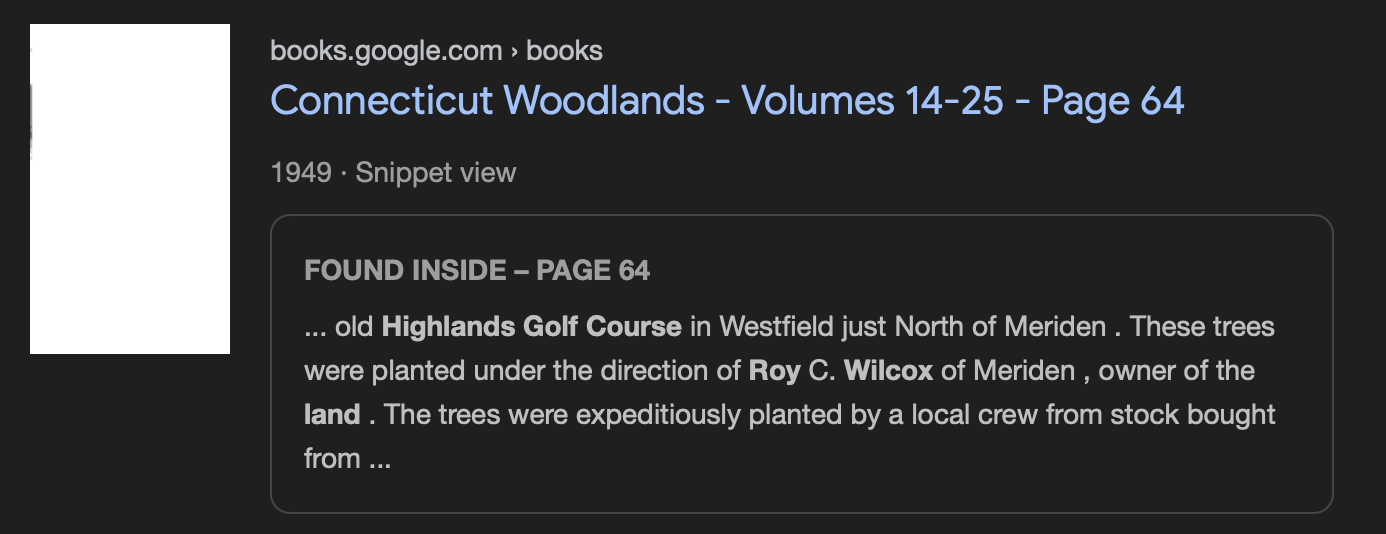
Thank you Roy C. Wilcox–who turned the Highland Country Club golf course into planted pines. Today it is known as Wilcox Conservation Area.
The country club hosted many, many events.
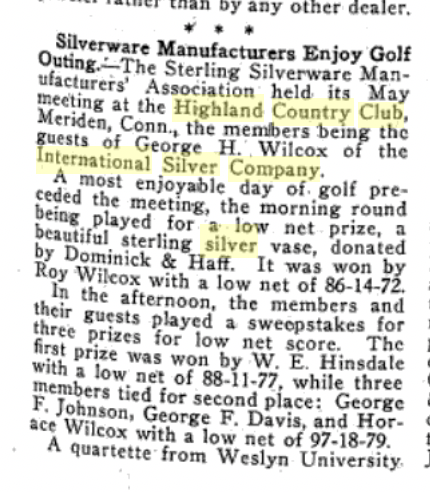
“The Sterling Silverware Manufacturers’
Association held its May meeting at the Highland Country Club, Meriden, Conn., the members being the guests of George H. Wilcox of the International Silver Company. A most enjoyable day of golf preceded the meeting, the morning round being played for a low net prize, a beautiful sterling silver vase, donated by Dominick & Haff. It was won by Roy Wilcox with a low net of 86-14-72.” From National Jeweler, linked to source of Google Books.
“He never went out without a book under his arm, and he often came back with two.” Victor Hugo